
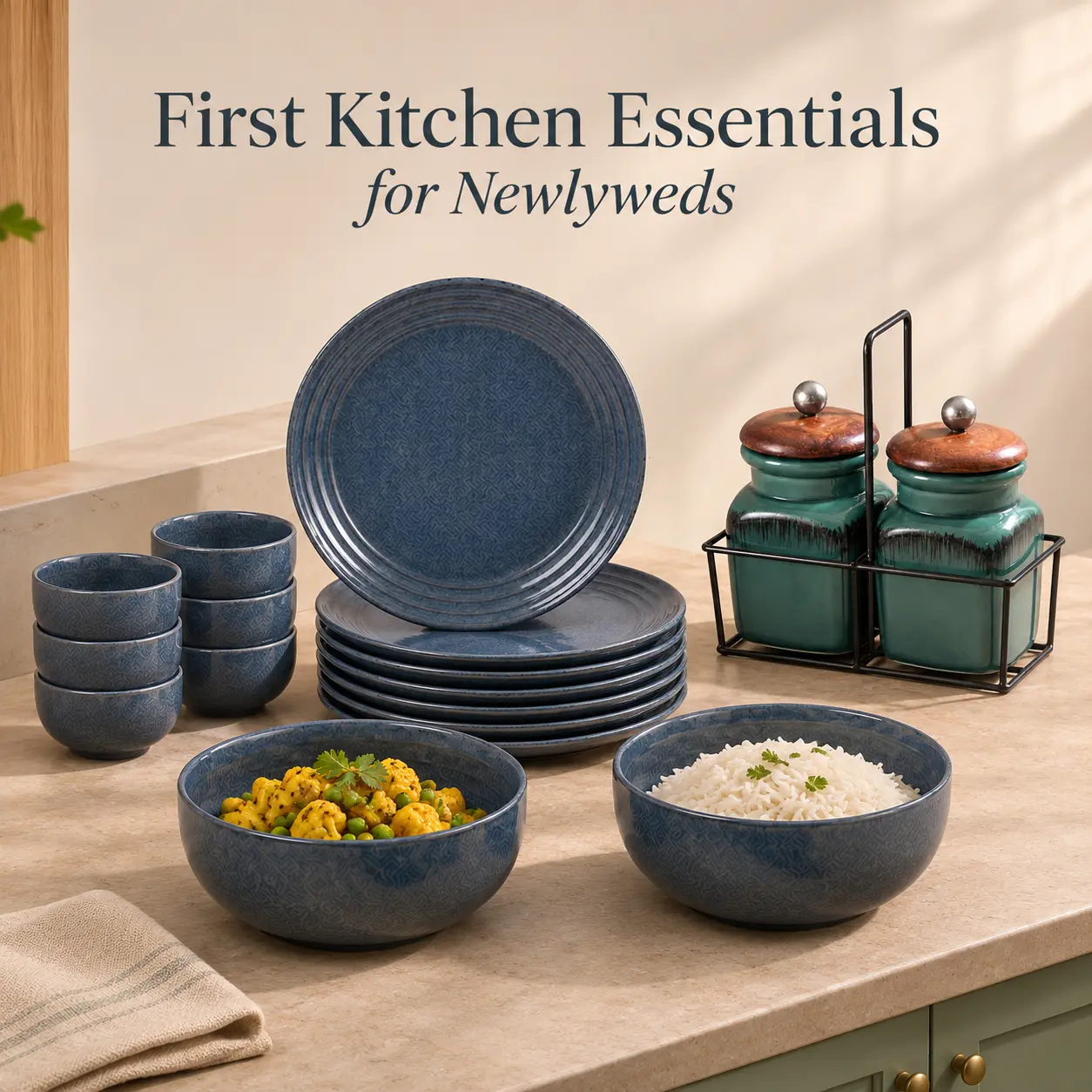
First Kitchen Essentials for Newlyweds
Your first kitchen together does not need everything on day one. It needs the things that make your everyday meals easier: cups for morning chai, plates for dinner, a few useful cooking tools and somewhere to keep the ingredients you reach for most.
The most useful kitchen essentials for newly married couples are the ones that suit how you actually live. Two people who cook every evening will need a different setup from a couple who mainly prepare breakfast and enjoy weekend meals at home.
Start with what you already own, check your cupboard space and build your collection gradually. These kitchen essentials for couples will help you create a home that feels considered, comfortable and genuinely yours.
Your First Kitchen Checklist
For a couple setting up a separate household, the following is a practical starting point—not a compulsory shopping list.
| Everyday need | What to consider first | What can wait |
|---|---|---|
| Cooking | Suitable cookware for your regular meals | Specialised pans used occasionally |
| Eating | Dinner plates, small bowls and cutlery | Multiple decorative dinner sets |
| Tea and coffee | Two cups that suit your preferred drinks | A large collection of different mugs |
| Drinking water | Everyday glasses | Several types of occasion-specific glassware |
| Serving | Bowls and serving spoons for shared dishes | Serveware for large celebrations |
| Storage | Containers suited to ingredients you actually buy | A complete matching pantry display |
| Preparation and cleaning | Knife, chopping board, essential utensils, dishwashing supplies and drying space | Gadgets without a clear everyday purpose |
If you are joining a shared family kitchen, check what is already available before buying a separate collection.
1. Check What You Already Have
Before shopping for new home kitchen essentials, unpack the products you already own and the gifts you have received.
Make three simple lists:
This prevents buying a second dinner set while overlooking serving spoons, or collecting several jars without knowing what will go inside them.
Think about your first week at home. Will you prepare poha and chai, make dal and rice, cook rotis and sabzi, or rely on quick one-pot meals? Your actual menu is a better shopping guide than a photograph of somebody else’s kitchen.
2. Choose Dinnerware for Couples Around Everyday Meals
Start by considering the food you enjoy and how often you wash dishes.
Dinner plates work for meals such as roti and sabzi, rice-based dishes or pasta. Small bowls are useful when you want dal, curd, chutney or another accompaniment served separately.
As an illustrative starting point, two people who wash dishes after each meal might choose two everyday place settings plus two spare settings. Adjust that quantity if you host often or wash larger batches less frequently.
Should you buy a complete dinner set?
A coordinated set can make sense when you want additional place settings for visitors. Separate pieces can be more practical if you already have plates or prefer to build your collection slowly.
The nestcase Reactive Blue 14-Piece Dinner Set contains:
That means six plate-and-bowl place settings with two shared serving bowls—not fourteen place settings. It is an option for couples who want matching pieces for everyday dining and smaller gatherings. nestcase.in
Before choosing a set, check its dimensions, cupboard fit and individual care instructions.
3. Pick Cups for Your Morning Routine
A pair of cups is a small purchase that can become part of a familiar daily ritual.
Choose by the drinks you actually make. A compact cup may suit a smaller serving of chai, while a larger cup offers more room for milk-based coffee or hot chocolate.
When comparing ceramic coffee mugs, look at:
The nestcase Speckled-Beige Coffee & Soup Cups come as a pair, with a listed capacity of 350 ml each. Their wide, handled form offers an option for couples who prefer a more generous cup. The product page also lists soup and hot chocolate among their uses. nestcase.in
You do not need to fill a cup to its stated capacity. Leave comfortable space for stirring and carrying.
Browse nestcase Cups & Mugs to choose a size and finish that feels right for your routine.
4. Choose Everyday Glasses Before Special-Occasion Glassware
Begin with glasses you will reach for regularly: drinking water with lunch, serving juice at breakfast or offering a cold drink to a visitor.
Check the capacity, grip, rim and storage space rather than choosing only by appearance.
The nestcase Geometric-Cut Clear Glasses are supplied as a set of six, with a listed capacity of 300 ml each. Although the product name refers to whisky glasses, the listing also specifies water, juice and mocktails as suitable uses. 300 ML Each
A six-piece set provides additional glasses when guests visit. However, if you already own suitable glasses, there is no need to replace them simply to make everything match.
Do not assume ordinary drinking glasses are suitable for boiling liquids, microwaving or oven use. Follow the instructions for the exact product.
5. Add Serving Bowls That Match Your Meals
Think about what needs to sit in the centre of your table.
For a simple dinner, you might use one bowl for dal and another for sabzi. On another evening, the same bowls could hold salad or a shared side dish, provided their size suits the food.
Choose serving bowls by:
If your dinner set already includes serving bowls, use those before buying additional pieces.
Explore nestcase Bowls & Platters when you have identified a specific gap in your collection.
6. Buy Storage Containers for Ingredients, Not Just for Display
A tidy kitchen does not require every ingredient to be transferred into a matching jar.
Start with the things you use frequently, such as tea, sugar or another suitable dry ingredient. Choose a container according to the ingredient’s storage instructions, how quickly you use it and the closure you need.
A decorative lid is not proof of an airtight seal. Confirm the product’s specifications before relying on it for moisture-sensitive ingredients.
When transferring food, retain important information such as expiry dates, allergens and preparation instructions. Avoid topping up old ingredients indefinitely without cleaning and drying the container appropriately.
The most useful storage is easy to identify, easy to reach and suited to what is inside.
7. Remember Cooking, Preparation and Cleaning Basics
Beautiful tableware is only one part of a working kitchen.
Choose cookware compatible with your hob and the meals you plan to cook. Depending on your routine, that might include a saucepan, a kadai or frying pan, a tawa and a pressure cooker.
You will also need appropriate preparation tools: a chopping board, a suitable knife, essential utensils and serving spoons.
Make room for cleaning from the beginning. Dishwashing supplies, a clean drying area, kitchen cloths and a waste bin deserve space alongside the products you use to cook and serve.
There is no need to buy every gadget immediately. Add a tool when it solves a task you perform regularly.
8. Make Space for Guests Without Overbuying
You can welcome family without owning separate collections for breakfast, lunch, dinner and every celebration.
Start with a versatile combination of plates, small bowls, cups and glasses. Add specialist pieces when you know you will use them.
For an occasional larger gathering, borrowing a few pieces can be more practical than permanently storing a second full collection.
If you are buying a present for another couple rather than setting up your own home, explore our Wedding Gifts Under ₹2,000 guide.
Before You Buy: Five Final Checks
- Quantity: Read exactly how many pieces are included.
- Dimensions: Measure the space where they will be used and stored.
- Capacity: Match bowls and cups to your usual servings.
- Care: Verify microwave, dishwasher and other permissions individually.
- Delivery: Review current delivery estimates, return eligibility and damage-reporting requirements.
These checks help you choose products for everyday use—not just for how they look online.
Frequently Asked Questions
What are the main kitchen essentials for newly married couples?
Start with cookware for your regular meals, dinner plates, small bowls, cutlery, cups, drinking glasses, suitable storage and basic preparation and cleaning tools. Check what you already own before purchasing more.
How many plates should a newly married couple buy?
There is no fixed number. Two everyday place settings plus two spares can be a starting example for a couple who wash frequently. Add more according to your washing routine, visitors and available storage.
Is a dinner set better than separate dinnerware for couples?
A dinner set can be convenient if you want coordinated pieces and extra place settings. Separate pieces suit couples who already own some crockery or want to add only what is missing. Compare the component list rather than the headline piece count.
Are ceramic coffee mugs a good choice for everyday use?
They can be, provided the size, handle and care requirements suit your routine. Check the individual product instructions rather than assuming all ceramic mugs have identical microwave or dishwasher permissions.
Which new home kitchen essentials can wait?
Specialised gadgets, multiple decorative sets and large quantities of occasional-use serveware can usually wait until you know how you cook and entertain. Prioritise frequently used items and suitable storage first.
How can we avoid buying too much?
Keep your first kitchen checklist divided into “already have,” “need now” and “can wait.” Review gifts, measure your cupboards and buy around your regular meals rather than trying to complete the entire kitchen in one order.
Build a Kitchen That Feels Like Yours
The right kitchen essentials for couples support small, familiar moments: breakfast before work, a shared cup of coffee and dinner after a long day.
Choose what you need now, leave room to discover your preferences and build the rest over time.
Explore nestcase dinner sets, cups and mugs, and glassware for pieces that bring considered design to your everyday table.