
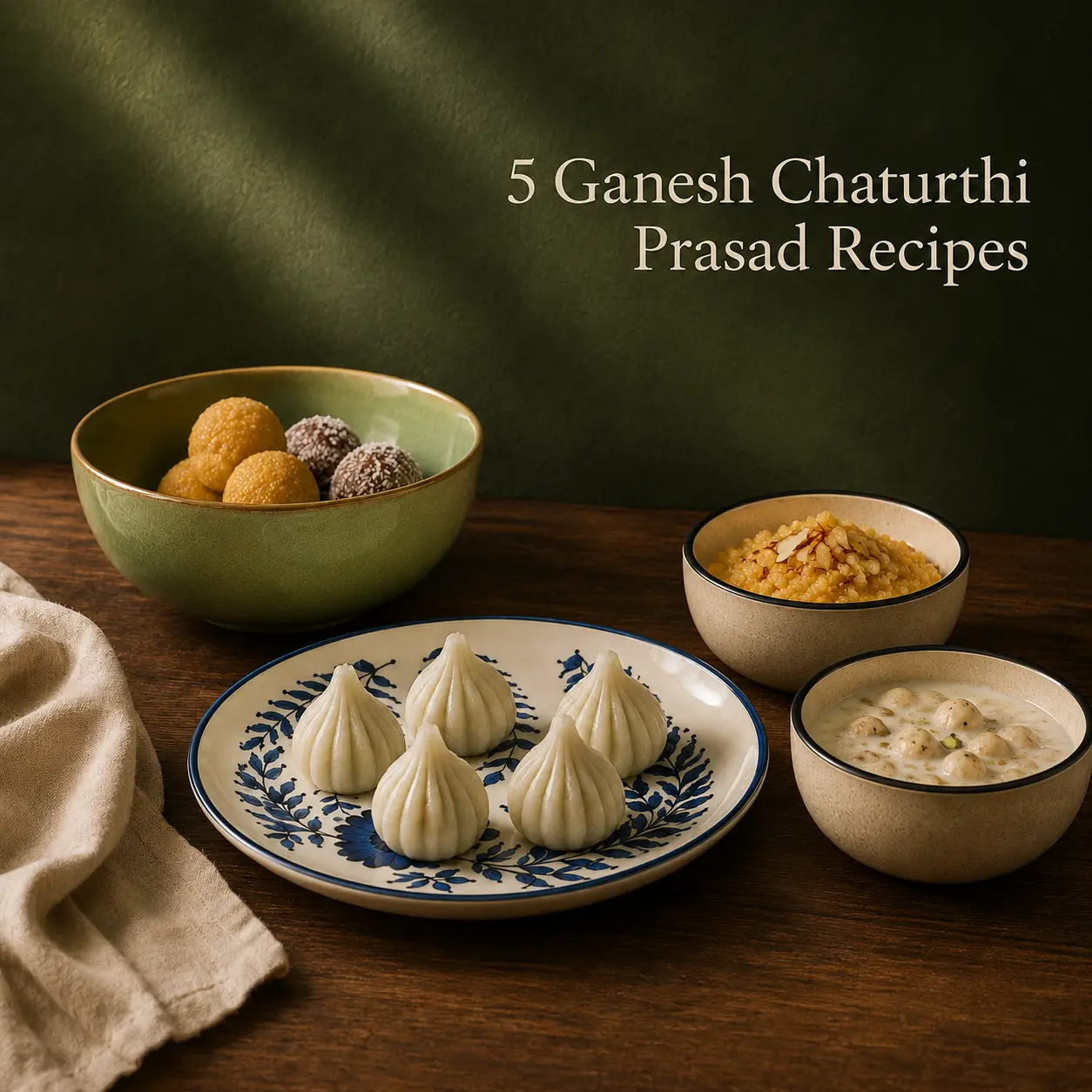
5 Ganesh Chaturthi Prasad Recipes You Can Make at Home
Ganesh Chaturthi is a time of devotion, family and food prepared with care. If you are planning a simple celebration at home, these five Ganesh Chaturthi prasad recipes offer a balanced mix of traditional and beginner-friendly sweets: steamed ukadiche modak, besan ladoo, rava sheera, coconut-jaggery ladoo and makhana kheer.
Each household follows its own customs, ingredient rules and offering traditions. Treat this collection as practical cooking guidance, and follow your family's religious practices when preparing and offering prasad. All utensils, surfaces and serving dishes should be clean and completely dry before you begin.
| Quick answer: For a manageable home menu, prepare one signature recipe such as ukadiche modak, one dry sweet such as besan or coconut ladoo, and one spoonable dessert such as rava sheera or makhana kheer. You do not need to make all five on the same day. |
Prasad menu at a glance
| Recipe | Approx. time | Yield | Best for |
| Ukadiche modak | 60 min | 10-12 | Traditional centrepiece |
| Besan ladoo | 45 min + cooling | 10-12 | Dry sweet |
| Rava sheera | 25 min | 4-6 servings | Quick warm prasad |
| Coconut-jaggery ladoo | 30 min | 10-12 | Simple festive sweet |
| Makhana kheer | 40 min | 4-6 servings | Creamy dessert |
Before you start
Read every recipe fully before heating ingredients.
Measure ingredients using the same cup and spoon set throughout.
Use fresh ingredients and check milk, coconut, nuts and ghee for freshness.
Keep allergen-containing ingredients such as dairy and nuts clearly identified.
Allow hot prasad to cool to a safe serving temperature before handling or serving.
Prepare food according to your household's customs; practices differ across families and regions.
1. Ukadiche Modak with Coconut and Jaggery
Prep: 25 minutes | Cook: 35 minutes | Yield: approximately 10-12 modaks
This ukadiche modak recipe is the most recognisable of these Ganesh Chaturthi prasad recipes. A soft rice-flour shell encloses a fragrant coconut-jaggery filling. The key is to keep the dough warm, moist and pliable while shaping.
Ingredients
For the filling: 1 cup freshly grated coconut
3/4 cup grated jaggery
1/4 teaspoon cardamom powder
1 teaspoon poppy seeds, optional and only if used in your household
1 teaspoon ghee
For the shell: 1 cup fine rice flour
1 1/4 cups water, with 1-2 tablespoons extra only if needed
1 teaspoon ghee
A small pinch of salt
Method
Heat 1 teaspoon ghee in a heavy pan. Add coconut and jaggery, then cook on low heat until the jaggery melts and the mixture thickens enough to hold together. Do not cook until dry or hard.
Stir in cardamom and optional poppy seeds. Transfer the filling to a plate and cool completely.
For the shell, bring 1 1/4 cups water, 1 teaspoon ghee and a small pinch of salt to a gentle boil.
Lower the heat, add the rice flour in one addition and mix firmly until no dry flour remains. Cover for 3-4 minutes, then switch off the heat.
When the dough is warm enough to handle, knead it until smooth. If it feels dry, wet your fingers rather than pouring in excess water.
Divide the dough into 10-12 portions. Keep unused portions covered with a damp cloth.
Flatten one portion into a small cup, keeping the centre slightly thicker than the pleated edge. Add 1-2 teaspoons of filling, pleat the edge and seal the top. A lightly greased mould may also be used.
Place the modaks in a greased steamer basket with space between them. Steam over simmering water for about 10-12 minutes, or until the exterior looks slightly glossy and cooked through.
Rest for 2-3 minutes before transferring carefully to a serving plate.
What usually goes wrong
Cracking shell: the dough may be too cool or dry; keep it covered and work while warm.
Leaking filling: the jaggery mixture may be too wet or the shell may be overfilled.
Dense shell: avoid making the dough layer excessively thick.
Collapsed shape: maintain a gentle simmer rather than an aggressive rolling boil in the steamer.
| Serve it with nestcase: Arrange the modaks in a loose ring on an exact nestcase Floral Blue or Olive-Green dinner plate, leaving the glaze visible around the food. Do not overcrowd or add unrelated crockery to the image. |
2. Besan Ladoo
Prep: 10 minutes | Cook: 25 minutes | Cooling and shaping: 20 minutes | Yield: approximately 10-12 ladoos
A dependable besan ladoo recipe needs patient roasting. The flour should lose its raw aroma and become nutty before sugar is added. Adding sugar while the mixture is very hot can make it loose or grainy.
Ingredients
1 cup fine besan (gram flour)
1/3 cup ghee, plus 1-2 teaspoons only if the roasted mixture remains too dry
1/2 cup finely powdered sugar
1/4 teaspoon cardamom powder
2 tablespoons chopped almonds or cashews, optional
1 tablespoon raisins, optional
Method
Heat ghee in a heavy pan over low heat. Add besan and mix until evenly coated.
Roast on low heat, stirring continuously and scraping the base. Continue until the colour deepens slightly and a nutty aroma develops, approximately 18-22 minutes depending on the pan and heat.
Add optional chopped nuts during the final 2 minutes of roasting.
Transfer the mixture to a wide plate and allow it to cool until comfortably warm, not hot.
Mix in powdered sugar and cardamom thoroughly.
Take small portions and press firmly into round ladoos. If the mixture will not bind after thorough mixing, add only a small quantity of warm ghee.
Allow the ladoos to set completely before arranging them for serving.
What usually goes wrong
Raw taste: the besan was not roasted long enough.
Loose mixture: sugar may have been added while the besan was too hot, or too much ghee was used.
Crumbly ladoos: knead a portion in your palm first; add extra ghee only if genuinely necessary.
Burnt flavour: low heat and constant stirring are essential.
| Serve it with nestcase: Use a nestcase 20.5 cm quarter plate or an exact 25 cm dinner plate for a neat dry-sweet presentation. Keep every ladoo visible and leave negative space around the serving. |
3. Rava Sheera with Cardamom
Prep: 5 minutes | Cook: 20 minutes | Serves: approximately 4-6
This rava sheera recipe is one of the quickest easy prasad recipes for a home celebration. Roasting the semolina properly and adding hot liquid gradually helps create a smooth texture without raw flavour or lumps.
Ingredients
1/2 cup fine rava or sooji
1/3 cup sugar, adjusted only after testing the final recipe
1 1/4 cups water
1/4 cup milk, or replace with water if that suits your household practice
3 tablespoons ghee
1/4 teaspoon cardamom powder
1 tablespoon chopped cashews
1 tablespoon raisins
A few saffron strands, optional
Method
Heat the water and milk together in a separate pan until hot. Do not leave milk unattended.
Heat 1 tablespoon ghee in a kadai and lightly fry the cashews and raisins. Remove and reserve.
Add the remaining ghee and rava. Roast on low to medium-low heat, stirring continuously, until aromatic and lightly golden.
Lower the heat. Add the hot liquid gradually while stirring carefully; the mixture may bubble and release steam.
Cover and cook on low heat until the rava absorbs the liquid and softens.
Add sugar and stir. The mixture will loosen before thickening again.
Cook until the sheera leaves the sides of the pan. Add cardamom, optional saffron, cashews and raisins.
Serve warm after it has cooled to a safe eating temperature.
What usually goes wrong
Lumpy texture: liquid was added too quickly without continuous stirring.
Raw flavour: the rava needed longer roasting.
Dry sheera: it was cooked too long after thickening.
Excess sweetness: measure the sugar rather than estimating directly over the pan.
| Serve it with nestcase: Serve individual portions in exact nestcase 220 ml katoris, or place a shared quantity in one 750 ml serving bowl. Keep the food below the rim so the authentic finish remains visible. |
4. Coconut-Jaggery Ladoo
Prep: 10 minutes | Cook: 15 minutes | Shaping: 10 minutes | Yield: approximately 10-12 ladoos
This coconut ladoo recipe uses jaggery for a warm, traditional flavour. It is simpler than steamed modak but still requires careful moisture control so the mixture binds without becoming wet or hard.
Ingredients
1 1/2 cups freshly grated coconut
3/4 cup grated jaggery
1 teaspoon ghee
1/4 teaspoon cardamom powder
1 tablespoon chopped nuts, optional
Method
Heat ghee in a heavy pan and add the grated coconut. Stir over low heat for 2-3 minutes without browning it.
Add jaggery and cook on low heat. Stir continuously as the jaggery melts and coats the coconut.
Continue until the mixture gathers together and a small portion can hold its shape when cooled briefly.
Mix in cardamom and optional nuts, then transfer the mixture to a plate.
When warm enough to handle safely, divide into 10-12 portions and roll into compact ladoos.
Cool completely before covering or storing. Follow conservative food-safety guidance for sweets made with fresh coconut.
What usually goes wrong
Wet mixture: it needs slightly more cooking to reduce moisture.
Hard ladoos: the jaggery-coconut mixture was cooked for too long.
Poor binding: shape while the mixture is warm and press firmly before rolling.
Browning coconut: keep the heat low and stir continuously.
| Serve it with nestcase: Arrange the ladoos on a nestcase Beige Dinner Plate with Black Rim for calm colour contrast. Use a clean food-safe liner only if it is part of the final styling and not presented as included with the product. |
5. Makhana Kheer
Prep: 10 minutes | Cook: 30 minutes | Serves: approximately 4-6
This makhana kheer recipe adds a spoonable dessert to the collection of Ganpati prasad recipes. Lightly roasting and crushing some of the makhana helps thicken the milk while leaving enough whole pieces for texture.
Ingredients
3 cups full-fat milk
1 1/2 cups makhana (fox nuts)
2 tablespoons ghee
3 tablespoons sugar, then adjust only after testing
1/4 teaspoon cardamom powder
1 tablespoon sliced almonds or pistachios, optional
A few saffron strands, optional
Method
Heat 1 tablespoon ghee in a pan. Roast the makhana on low heat until crisp, then cool slightly.
Crush about one-third of the roasted makhana coarsely and keep the remaining pieces whole or halved.
Bring milk to a gentle simmer in a heavy pan, stirring regularly to prevent scorching.
Add the crushed and whole makhana. Simmer on low heat for approximately 15-20 minutes, stirring frequently, until the makhana softens and the milk thickens.
Add sugar, cardamom and optional saffron. Simmer for another 3-4 minutes.
Finish with optional nuts. Serve warm, or cool promptly and refrigerate according to safe dairy handling practices.
What usually goes wrong
Thin kheer: simmer longer on low heat while stirring regularly.
Scorched milk: use a heavy pan, low heat and frequent stirring.
Very soft makhana: reserve a small portion of roasted pieces and add them near the end if you prefer more texture.
Overly thick chilled kheer: it will thicken as it cools; account for that before reducing excessively.
| Serve it with nestcase: Use exact nestcase 220 ml small bowls for individual servings or one 750 ml serving bowl for a shared presentation. Do not fill to the rim; keep the glaze visible and make carrying safer. |
How to plan these Ganesh Chaturthi recipes
Making every recipe is not necessary. Choose according to your time, skill and family tradition. A first-time cook can pair rava sheera with coconut-jaggery ladoo. A more experienced cook may centre the menu on ukadiche modak and add makhana kheer for guests.
For a traditional focus: ukadiche modak + rava sheera.
For a simpler menu: coconut-jaggery ladoo + makhana kheer.
For dry sweets: besan ladoo + coconut-jaggery ladoo.
For a larger family meal: one prasad recipe plus a complete vegetarian lunch, served separately.
Food-safety and allergy notes
Milk-based kheer and sweets containing fresh coconut require careful temperature control and conservative storage.
Nuts, dairy, ghee and poppy seeds may be unsuitable for some people; disclose ingredients before serving.
Do not leave dairy-based prasad at room temperature for extended periods, particularly in warm weather.
Use separate clean utensils for tasting and serving.
Discard food if freshness, storage conditions or contamination are uncertain.
This article provides general cooking information and does not replace medical advice for allergies or dietary restrictions.
Frequently asked questions
What prasad can be made for Ganesh Chaturthi?
Common home options include modak, ladoo, sheera and kheer, but traditions differ. These five Ganesh Chaturthi prasad recipes provide practical choices rather than a mandatory religious menu.
Which is the easiest Ganpati prasad recipe for beginners?
Rava sheera is usually the quickest of these easy prasad recipes because it needs no shaping. Careful roasting and gradual liquid addition remain important.
Can modak be made without a mould?
Yes. Divide warm rice-flour dough into portions, shape each into a cup, add filling, form pleats and seal the top. A mould improves consistency but is not essential.
Why does ukadiche modak crack?
The dough may be too dry, cold or insufficiently kneaded. Keep it warm and covered, and wet your fingers lightly while shaping.
How do you stop modak filling from leaking?
Cool and thicken the coconut-jaggery filling, avoid overfilling and seal every opening before steaming.
Can Ganesh Chaturthi prasad be prepared in advance?
Follow your household's offering customs first. From a food-safety perspective, storage depends on the ingredients; fresh coconut and dairy preparations need more conservative handling than dry sweets.
Can jaggery replace sugar in every recipe?
Not automatically. Jaggery changes moisture, flavour and structure. Use a specifically tested jaggery formulation rather than replacing sugar cup-for-cup.
How should prasad be served at home?
Use clean, undamaged food-safe dinnerware. Small katoris suit sheera and kheer, while plates suit modak and ladoo. Religious serving practices vary by household.
How many modaks does this recipe make?
The recipe is designed for approximately 10-12 medium modaks, but yield changes with shell thickness and mould size.
Can these recipes be made nut-free?
The optional nuts can be omitted, but check every packaged ingredient for cross-contact warnings when cooking for someone with an allergy.