
Kitchen Storage Essentials: How to Choose Ceramic Jars and Oil & Vinegar Dispensers
A kitchen often feels disorganised because everyday ingredients have no settled place. Tea packets collect beside the kettle, sugar moves between cupboards, and cooking oil stays wherever it was last used. Even a spacious worktop can feel crowded when these small things keep shifting around.
Choosing the right kitchen storage essentials can make these routines easier. Ceramic kitchen jars give suitable dry ingredients a designated home, while an oil and vinegar dispenser keeps frequently used liquids convenient to pour and return. Together, they can help create a kitchen that feels considered and comfortable to use.
The best choices depend on what you cook, how quickly you use ingredients and how much space you have. Whether you are refreshing your kitchen before Diwali or improving your everyday setup, this guide explains what to check before choosing jars, dispensers and coordinated storage sets.
Start With the Ingredients You Use Most
Before buying new containers, look at your normal cooking day. What do you reach for when making breakfast? Which ingredients come out during dinner preparation? What stays untouched for weeks?
Tea, sugar, coffee, cooking oil and everyday seasonings may deserve easy access. Larger refill packs and occasional ingredients can remain in suitable cupboard storage.
This gives each container a clear purpose. A jar chosen for daily tea should be easy to open and scoop from. A dispenser used while preparing meals should be comfortable to hold, pour and clean. A decorative canister should still suit the ingredient placed inside it.
Simple kitchen storage ideas work best when they follow your habits. Begin with one area that regularly becomes untidy, then choose the pieces that solve that particular problem.
Ceramic Jars and Dispensers Serve Different Purposes
A coordinated kitchen can use several materials without requiring every container to look identical. What matters is whether each item performs its job well.
| Everyday task | Useful option | What to check |
|---|---|---|
| Scooping tea, coffee or sugar | Ceramic jar suitable for the ingredient | Opening width, lid fit and capacity |
| Keeping two beverage ingredients together | Tea and sugar jars with a stand | Total footprint and access to both jars |
| Storing an identified dry ingredient | Labelled ceramic storage jar | Closure, cleaning instructions and food suitability |
| Pouring oil or vinegar | Dispenser intended for that liquid | Grip, pouring spout, closure and cleaning access |
| Keeping table seasonings together | Condiment set with a caddy | Included pieces, stability and ease of removal |
An attractive container earns its place when it is convenient to use, straightforward to maintain and appropriately sized for its contents.
How to Choose Ceramic Kitchen Jars
Ceramic kitchen jars bring colour and texture to a worktop or shelf. Their opaque bodies also mean that you need a clear way to identify what is inside. Consider both their appearance and their everyday handling before choosing a set.
Choose Capacity Around Your Refill Routine
Start with the amount you normally keep accessible between refills.
A household that makes tea several times a day may prefer a larger working supply than someone who occasionally makes a single cup. Buying the biggest jar available can use unnecessary shelf space, while a very small jar may need constant refilling.
Remember that millilitres measure volume. A 500 ml jar does not necessarily hold 500 grams of tea, sugar or coffee. Different ingredients occupy space differently.
Check the listed capacity alongside the jar’s external dimensions. Allow enough room to remove the lid and use a spoon without knocking neighbouring items.
Check the Opening and Lid
The mouth of the jar should suit how you use its contents. If you scoop sugar with a particular spoon, check whether the opening provides enough clearance. Consider whether the lid is comfortable to lift and where you will place it while using the jar.
A lid’s appearance does not establish how well it seals. When comparing ceramic storage jars, check the individual product’s closure details instead of assuming every fitted lid is airtight.
Also consider the lid material. A wooden lid may need different cleaning and drying care from the ceramic body.
Make the Contents Easy to Identify
Labels are especially useful when several jars have similar shapes or finishes. Keep the description simple and accurate: tea, sugar or the specific ingredient name.
If you transfer an ingredient from its original packaging, retain its storage instructions, date information and relevant allergen details. A neatly labelled jar should make the kitchen easier to use without losing information from the original pack.
Create a Convenient Tea-and-Sugar Corner
Tea and sugar jars work well as a pair when those ingredients are regularly used together. Place them where you prepare drinks, with enough space for scooping, setting down a cup and wiping the surrounding surface.
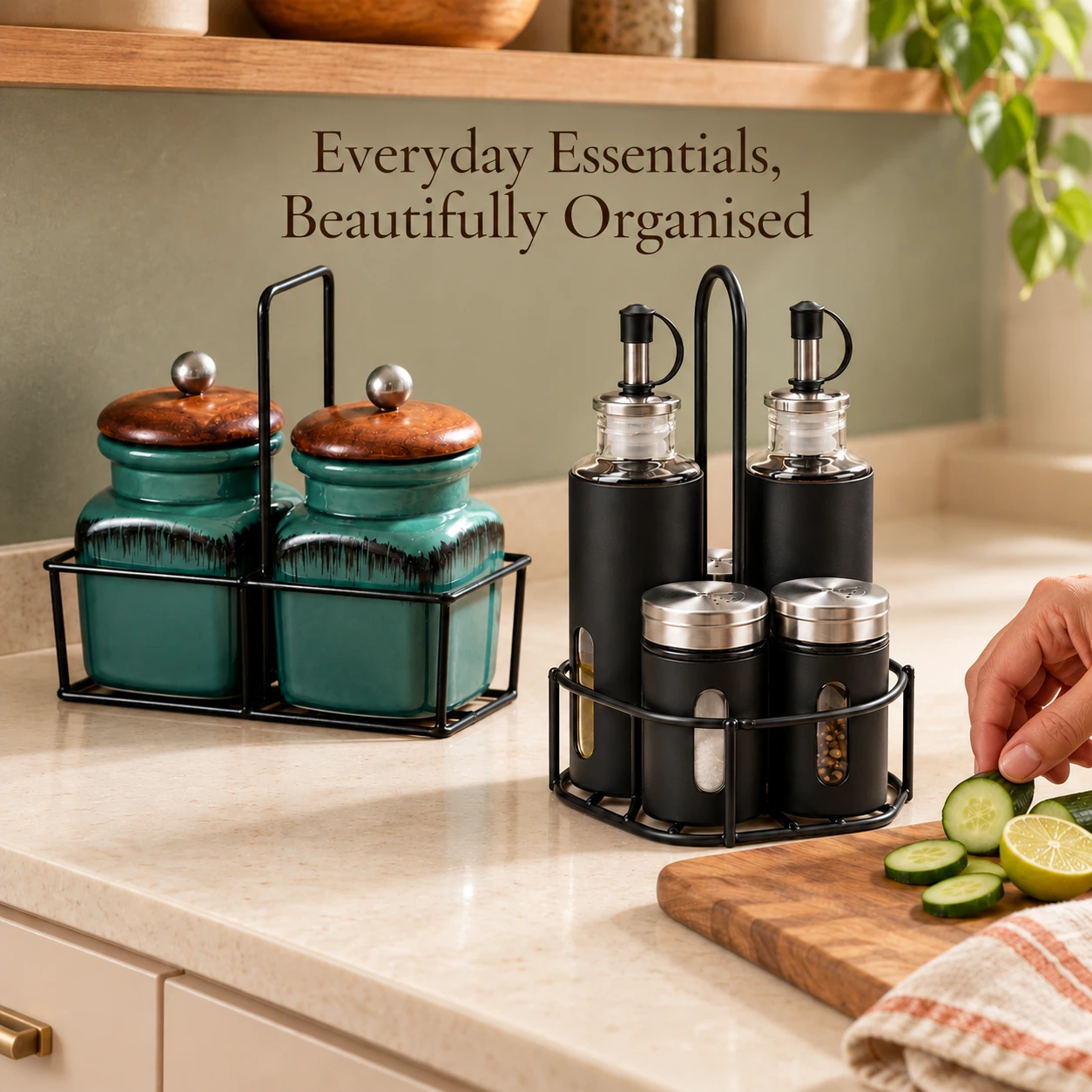
The nestcase Ceramic Tea & Sugar Jars Set includes two 500 ml ceramic canisters with a coordinating stand. It provides a defined place for the pair and can help keep the beverage area visually organised. 500 ml Each with Stand
Measure the complete arrangement before choosing a stand-based set. Check that you can lift each jar comfortably beneath overhead cupboards and reach both containers without moving other items.
Keep the surrounding setup modest. Frequently used cups and a teaspoon may be helpful nearby, while spare packets can stay in their appropriate storage location. Leave room for the actual task of preparing drinks.
Add Character With a Single Ceramic Storage Jar
A single patterned jar can introduce colour without requiring a complete kitchen makeover. It can also be a practical option when you only need a dedicated container for one ingredient.
The nestcase Hand-Painted Ceramic Storage Jar with Wooden Lid has an approximately 700 ml capacity and a multicolour finish. Its listing identifies uses including tea, coffee, sugar, spices and dry fruits. Hand-painted details and natural wood grain may vary between pieces. nykaafashion.com
Choose its contents according to the ingredient’s requirements and the jar’s closure. Give it a location where it can be reached easily and lifted without brushing against other objects.
For styling, let the pattern provide the main decorative detail. A simple shelf, plain backdrop or restrained textile can give the jar enough visual space. This keeps ceramic storage jars useful while allowing their finish to become part of the kitchen’s character.
How to Choose an Oil and Vinegar Dispenser
An oil and vinegar dispenser is useful when you regularly need a manageable bottle for cooking preparation or table service. Its shape and pouring components deserve as much attention as its appearance.
Look for a Comfortable Grip
Consider how the bottle will feel when filled. A slim bottle may be easy for one person to hold but less comfortable for another. Check its dimensions, weight where available and the space around it inside a caddy.
You should be able to remove and return the bottle without catching the spout or disturbing nearby containers.
Examine the Pouring Spout and Closure
Choose a dispenser intended for the liquid you plan to use. Oil and vinegar can behave differently when poured, so inspect the product’s stated uses and dispensing arrangement.
A pouring spout does not automatically make a bottle leakproof or guarantee a mess-free pour. Look for specific product information and keep the bottle upright during normal use and storage.
If precise quantities matter to a recipe, pour into a measuring spoon or jug. The dispenser makes the ingredient accessible; it does not replace a measuring tool unless it has a verified measuring function.
Check How It Opens for Refilling and Cleaning
A useful oil dispenser for kitchen use should be practical to refill without obscuring the bottle opening. Consider whether its dispensing parts can be removed and cleaned as directed.
Capacity should suit your rate of use and the ingredient’s storage instructions. Keep the original bottle or its label information available, including the oil or vinegar type and any instructions after opening.
Keep Oil, Vinegar, Salt and Pepper Together
A condiment set can be helpful when the same seasonings are regularly used during preparation and at the dining table.
The nestcase Oil, Vinegar, Salt & Pepper Dispenser Set contains:
The five-piece arrangement keeps four condiment containers together in one holder. Its coordinated black finish can sit comfortably alongside coloured ceramic jars or a neutral kitchen palette. nykaafashion.com
Give each bottle a clear identity so oil and vinegar are easy to distinguish. Check the caddy’s footprint and make sure each piece can be removed independently.
Use the set for the seasonings your household actually reaches for. A coordinated arrangement is most useful when its contents support everyday meals.
Where Should Kitchen Jars and Dispensers Be Placed?
Kitchen counter organisation becomes easier when objects are positioned around the task they support.
Keep tea and sugar near your beverage preparation area. Place frequently used condiments where you can reach them during preparation, while respecting the storage instructions for their contents.
Avoid positioning ingredient containers where they receive direct heat, cooking steam, repeated sink splashes or strong sunlight. Convenient access does not require placing oil bottles immediately beside a hot hob.
For a small worktop, try a compact arrangement with three distinct areas:
- A beverage group containing your regularly used tea and sugar jars.
- A condiment group containing the dispensers and seasonings you need.
- A clear preparation area for chopping, mixing and plating.
These are starting points, not a requirement to fill every area. If vinegar is rarely used, it may be better kept in its appropriate cupboard location.
Make the Collection Feel Coordinated
A cohesive kitchen does not need an identical colour or material across every piece. Ceramic, glass, wood and metal can work together when the arrangement remains simple.
Choose one main colour direction and allow a few finishes to repeat. For example, a neutral backdrop can support patterned ceramic jars, while black details can connect a dispenser caddy with existing handles or appliances.
Keep taller pieces where they do not hide smaller containers. Leave space between groups so each item is easy to identify and return.
For a festive kitchen refresh, work with the storage you already use. A carefully chosen jar or condiment set can make a visible difference without requiring extra decorations on a busy cooking surface.
How to Clean and Refill Your Kitchen Storage Essentials
Regular care helps jars and dispensers remain pleasant to use. Follow the instructions for the specific product, including separate guidance for lids, dispensing parts and stands.
For the nestcase hand-painted 700 ml jar, the listed care instructions recommend gentle hand washing of the ceramic body with mild detergent and a soft sponge. Wipe the wooden lid with a slightly damp cloth and dry it immediately. nykaafashion.com
The nestcase condiment set’s guidance recommends gentle hand washing of its bottles, shaker jars and removable dispensing parts with mild detergent and lukewarm water. nykaafashion.com
Build a simple refill routine:
Avoid repeatedly topping up containers in a way that mixes old and new contents or makes their dates difficult to track.
Common Mistakes to Avoid
The most useful kitchen storage ideas account for daily handling, not just the finished photograph.
Avoid choosing jars without checking their dimensions, assuming all lids provide the same seal or buying a dispenser without considering how it will be cleaned. Do not fill every available space with containers if doing so leaves too little room to prepare food.
It is also easy to remove packaging and forget what information it held. Keep ingredient names and storage instructions accessible, particularly when several containers look similar.
Choose gradually. Use a new piece for a few days, notice whether it improves the routine and adjust its position before adding more.
Frequently Asked Questions
What should I look for when buying ceramic kitchen jars?
Check food suitability, capacity, external dimensions, opening width, lid fit and care instructions. Choose a size that suits your refill routine and fits comfortably in its intended location.
Can ceramic jars be used for tea, coffee and sugar?
Ceramic jars designed for these ingredients can be useful. Check the individual jar’s closure and follow the ingredient’s storage instructions. Keep the container clean, dry and clearly identified.
Are all ceramic storage jars airtight?
No. Airtightness depends on the lid and sealing arrangement, not simply the ceramic body. Check the exact product information rather than judging from its appearance.
What does a 500 ml jar hold?
It holds approximately 500 ml by volume, subject to the product’s stated capacity. The weight of ingredients that fit inside varies, so it should not be treated as a 500 g container for every food.
What should I check in an oil and vinegar dispenser?
Look at its intended use, capacity, grip, spout, closure and cleaning access. Also check the included pieces if it is sold with shakers or a caddy.
Can an oil dispenser be kept next to the stove?
Choose a location away from direct heat and cooking splashes, following the oil manufacturer’s storage instructions. Keep it accessible without exposing it to heat simply for convenience.
How do I organise jars in a small kitchen?
Group items according to the task they support, keep frequently used ingredients accessible and preserve a clear preparation surface. Measure any stand or caddy as a complete unit before buying.
Can I wash wooden jar lids with the ceramic body?
Follow the product’s separate care instructions. For nestcase’s hand-painted 700 ml jar, the wooden lid should be wiped with a slightly damp cloth and dried immediately rather than washed like the ceramic body. nykaafashion.com
Choose Storage That Works With Your Everyday Routine
Thoughtful kitchen storage essentials give familiar ingredients a dependable place. Ceramic jars can make scooping and storing more organised, while an oil and vinegar dispenser can keep everyday condiments convenient to use.
Start with the ingredients you reach for most, choose appropriate capacities and leave room to work. Explore nestcase’s collection and the 500 ml Tea & Sugar Jar Set with Stand to build a kitchen arrangement that feels useful, personal and easy to maintain.