
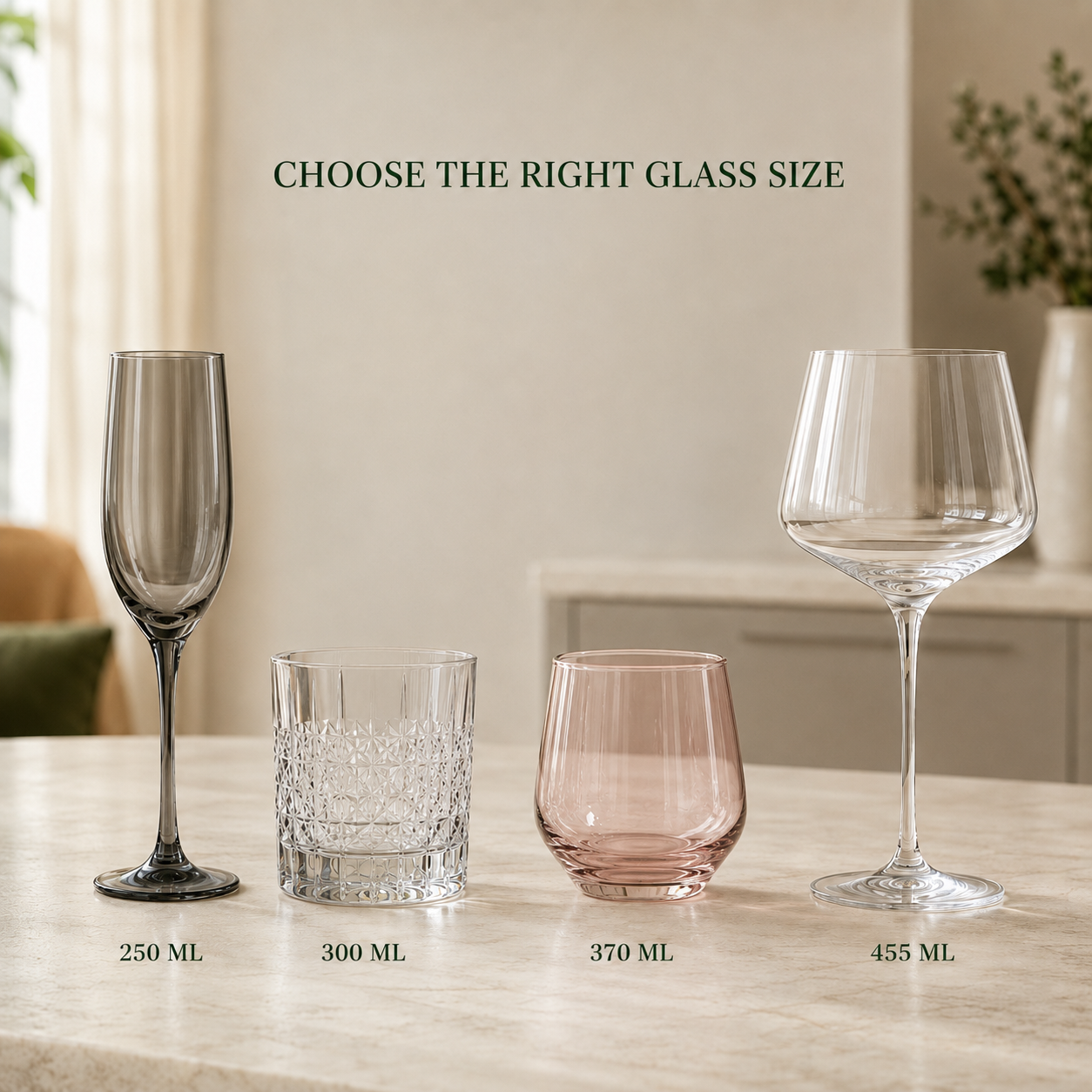
How to Choose the Right Glass Size: 250 ml, 300 ml, 370 ml or 455 ml?
Choosing glassware based only on appearance can leave you with a glass that is too small for ice and garnish, too large for an everyday pour or difficult to store. A practical glassware size guide considers capacity, shape, beverage type, headroom and how often the glass will be used.
A 250 ml glass, 300 ml glass, 370 ml glass and 455 ml wine glass can all serve different purposes. However, the capacity printed on a product page usually represents the glass’s maximum capacity—not the amount you should pour every time. Your comfortable serving quantity will be lower once you allow space for ice, fruit, foam, carbonation and safe carrying.
This drinking glass capacity guide will help you understand what size drinking glasses to buy for water, juice, coolers, mocktails, sparkling beverages and entertaining.
Quick answer: which glass size should you choose?
Choose a glass size according to the drink and the space it requires:
For most households, a 300 ml glass is a versatile everyday choice. A 370 ml glass gives you greater flexibility for ice-based drinks, while a 455 ml wine glass is better when bowl space, aroma and presentation matter.
Explore the complete nestcase glassware collection to compare different shapes, capacities and sets.
Glassware size comparison
| Glass capacity | Best suited to | Main advantage | Consider before buying |
|---|---|---|---|
| 250 ml | Sparkling drinks, smaller mocktails and celebratory servings | Compact and refined | Limited space for large ice cubes and heavy garnishes |
| 300 ml | Water, juice, whisky, soda and everyday mocktails | Versatile for regular use | Shape determines how much ice fits comfortably |
| 370 ml | Coolers, mocktails, iced beverages and mixed drinks | More space for ice and garnish | Requires more cabinet and table space |
| 455 ml | Wine, spritzes and spacious presentation | Generous bowl and visual impact | Not necessary for every everyday beverage |
This table is a starting point, not a strict serving rule. Two glasses with identical capacity may still feel different because of their height, diameter, rim, base and bowl shape.
What does glass capacity actually mean?
Drinking glass capacity generally refers to the maximum volume the glass can contain when filled close to its rim. Libbey explains that its glass capacity is measured to overflow, illustrating why listed capacity should not automatically be treated as a comfortable serving quantity. Libbey’s glass-capacity explanation.
If a product is described as a 300 ml glass, that does not mean every drink should contain 300 ml of liquid. You still need space for:
A useful glassware size guide must therefore distinguish between total capacity and comfortable fill level.
Total capacity
This is the quantity the glass can hold near its upper limit.
Comfortable serving capacity
This is the practical quantity that leaves suitable headroom. It changes according to the drink, amount of ice, garnish and glass shape.
Recipe volume
This is the combined volume of the beverage ingredients before or after adding ice. It may not correspond exactly with the glass’s listed capacity.
For consistent results, follow the drink recipe and product information rather than assuming that the full drinking glass capacity must be used.
When should you choose a 250 ml glass?
A 250 ml glass is a compact option for refined servings, smaller mixed drinks and sparkling beverages. It is especially useful when you want the drink to feel considered without using an oversized glass.
A 250 ml glass can suit:
The nestcase 250 ml Champagne Glass Set of 6 uses a tall flute form. Its narrow profile is visually distinct from a short tumbler, even though both may hold a similar quantity.
Advantages of 250 ml glasses
Limitations of 250 ml glasses
A 250 ml glass may not be the right choice for a drink requiring several large ice cubes, fruit pieces and a generous quantity of mixer. Large garnishes can also make a compact glass feel crowded.
Choose a 250 ml glass when the drink requires presentation and a controlled pour rather than maximum space.
When should you choose a 300 ml glass?
A 300 ml glass is one of the most adaptable choices for an everyday household. It provides more room than compact stemware without becoming unnecessarily large.
A 300 ml glass can be used for:
The nestcase 300 ml Geometric-Cut Clear Whiskey Glasses—Set of 6 combine a short tumbler form with space for suitable ice and mixers.
Those seeking a warmer visual finish can also consider the nestcase 300 ml Wavy Whisky Glasses—Set of 6.
Is 300 ml a standard drinking-glass size?
There is no single universal standard drinking glass size. Glasses are made in many capacities and shapes. Nevertheless, a 300 ml glass is a practical middle-sized option for many everyday drinks.
If you are wondering what size drinking glasses to buy for regular family use, 300 ml is a useful starting point because it accommodates water, juice, ice and many simple mocktails.
When a 300 ml glass may feel small
A 300 ml glass can become crowded when a drink contains:
In those cases, moving to a 370 ml glass may be more practical.
When should you choose a 370 ml glass?
A 370 ml glass creates additional space for ice, mixers and visible garnishes. It is suitable for people who enjoy longer cold beverages or more elaborate mocktail presentation.
A 370 ml glass can suit:
The nestcase 370 ml Pink Whiskey Glasses—Set of 6 offer a coloured-glass option for entertaining and contemporary tables.
Why choose 370 ml instead of 300 ml?
The difference is not simply an extra 70 ml of liquid. A 370 ml glass can provide more practical space for:
For a party where you plan to serve ice-heavy coolers, a 370 ml glass may be more flexible than a compact tumbler.
Is a 370 ml glass too large for everyday use?
Not necessarily. It depends on the shape and the user’s preferred beverages. It may feel larger than required for a small juice or whisky serving, but it can work well for water, cold coffee and mixed drinks.
Check the glass diameter, height and cabinet space in addition to its drinking glass capacity.
When should you choose a 455 ml glass?
A 455 ml glass is the most spacious option in this comparison. In stemware, the larger bowl is not intended to be filled completely. The open space forms part of the presentation and allows a suitable beverage to move within the bowl.
A 455 ml wine glass can work for:
The nestcase 455 ml Red Wine Glasses—Set of 6 feature a flat-bottom bowl and long stem designed to create a distinctive table presentation.
Does a 455 ml wine glass require a 455 ml pour?
No. A 455 ml wine glass should not automatically receive 455 ml of beverage. The full number describes capacity, while the appropriate pour depends on the beverage, recipe and occasion.
The empty portion of a spacious wine glass is intentional. It provides visual balance and room for the drink rather than indicating that the glass is underfilled.
When should you avoid a 455 ml glass?
Choose a smaller option if:
A 455 ml wine glass offers impact and space, but it is not automatically the best glass for every drink.
What is the best glass size for mocktails?
There is no single best glass size for mocktails. Match the capacity to the drink’s ingredients, ice and garnish.
For sparkling mocktails
A 250 ml flute can work for sparkling apple, grape, citrus or alcohol-free celebratory beverages that do not contain bulky garnishes.
For short mocktails
A 300 ml tumbler is suitable for compact drinks served with a moderate quantity of ice.
For fruit coolers
A 370 ml glass provides more space for citrus, mint, fruit, mixer and ice.
For spritz-style drinks
A 455 ml stemmed glass creates room for ice, sparkling mixer and restrained garnish.
When choosing a glass size for mocktails, calculate the recipe volume first and then allow room for ice and headspace. Do not select the glass solely because it is traditionally associated with an alcoholic beverage. A whisky glass, wine glass or champagne flute can also present suitable alcohol-free drinks.
What is the right whisky-glass capacity?
A practical whisky glass capacity depends on whether the drink is served neat, with water, over ice or with a mixer.
A compact pour requires less room, while large ice cubes and mixers require a wider or larger glass. A 300 ml tumbler can offer a useful balance between comfortable grip, ice space and table presence.
When comparing whisky glass capacity, also consider:
Capacity alone does not determine how the glass will feel in use.
What cocktail-glass size should you choose?
The right cocktail glass size depends on the finished recipe rather than the drink’s name.
For example:
Before choosing a cocktail glass size, add together the recipe ingredients and consider the volume displaced by ice. Leave enough room to carry the drink without spilling.
How glass shape changes usable space
Capacity tells you how much a glass can hold, but shape determines how that space is distributed.
Short tumblers
Short tumblers commonly offer:
Tall flutes
Tall flutes provide:
Large stemmed glasses
Large stemmed glasses provide:
Two glasses with the same standard drinking glass size or listed capacity may therefore perform very differently.
Which glass size is best for everyday use?
For everyday water, juice and simple cold drinks, a 300 ml glass is generally the most adaptable among these four options. It offers a useful balance of capacity, grip, storage and table space.
Choose 370 ml if your household frequently serves:
Keep 250 ml stemware for smaller sparkling beverages and celebrations. Choose 455 ml stemware when you want a more spacious wine or spritz presentation.
The best answer to what size drinking glasses to buy depends on what your household actually drinks—not on building a large collection for hypothetical occasions.
What size glasses are best for a house party?
For most house parties, versatility matters more than owning a separate glass for every beverage.
A practical setup could include:
A set of six is convenient when serving a small group, but the required quantity depends on the guest count, menu, washing plan and whether guests will reuse the same glass.
Avoid placing every type of glassware on the table at once. Bring out only the styles required for the drinks being served.
How many drinking glasses should you buy?
Consider:
- Number of household members:Frequency of guests
- Daily beverage habits:Dishwasher or washing frequency
- Available cabinet space:Whether one versatile glass can serve several purposes
A couple may prefer one compact set, while a larger family or frequent host may benefit from coordinated sets of six.
When deciding what size drinking glasses to buy, begin with the glass used most often. Add specialised flutes or stemware only when they suit your real serving habits.
Storage considerations before choosing glassware
Larger capacity often means a taller or wider glass, but not always. Measure your cabinet before purchasing.
Check:
A 455 ml wine glass may require more vertical clearance than a 370 ml tumbler. Meanwhile, tall 250 ml flutes can require more height despite their smaller drinking glass capacity.
Store every glass completely clean and dry. Do not stack products unless their design and care instructions make stacking appropriate.
Common mistakes when choosing a glass size
A reliable glassware size guide should help you avoid these problems rather than prescribe one capacity for every household.
Final glass-size checklist
Before choosing between a 250 ml glass, 300 ml glass, 370 ml glass and 455 ml wine glass, ask:
Explore glassware by size and use
The easiest way to choose glassware is to begin with your real serving habits:
You can also browse all nestcase glassware or view the stemware collection.
Frequently asked questions
What is a standard drinking-glass size?
There is no universal standard drinking glass size. Everyday drinking glasses are sold in numerous capacities and shapes. A capacity around 300 ml is versatile for many households, but the right choice depends on the drink, ice, preferred pour and available storage.
Is a 250 ml glass big enough for water?
A 250 ml glass can hold a compact water serving, but it may require more frequent refilling. A 300 ml or 370 ml glass may be more convenient for regular water service.
Is a 300 ml glass suitable for everyday use?
Yes. A 300 ml glass can be used for water, juice, iced tea, soda and many simple mocktails. Its versatility makes it a practical starting point for an everyday collection.
What can be served in a 370 ml glass?
A 370 ml glass can present water, cold coffee, juice, fruit coolers, soda-based drinks and mocktails requiring additional room for ice or garnish.
Is a 455 ml wine glass too large?
A 455 ml wine glass is spacious, but it is not intended to be filled completely. The larger bowl provides room for movement and presentation. Its suitability depends on the beverage and available storage.
What is the best glass size for mocktails?
The best glass size for mocktails depends on recipe volume and ice. Use 250 ml for smaller sparkling drinks, 300 ml for short mocktails, 370 ml for ice-heavy coolers and 455 ml for spacious spritz-style presentation.
Does ice count towards glass capacity?
Ice displaces liquid and occupies space inside the glass. Select a larger glass when the drink requires several cubes or crushed ice, and retain enough headroom for stirring and carrying.
Should a drinking glass be filled to the rim?
No. Filling a glass to the rim makes it harder to carry and leaves no room for ice, garnish, foam or movement. Treat the published capacity as a product measurement rather than a compulsory serving quantity.
What is a suitable whisky-glass capacity?
There is no universal whisky glass capacity. A 300 ml tumbler can accommodate suitable ice and mixers, while a smaller serving may require only part of that capacity.
Does glass shape matter more than capacity?
Both matter. Capacity indicates the available volume, while shape affects stability, ice placement, garnish space, grip, aroma and storage. Compare both before purchasing.
Conclusion
The right glass is not necessarily the largest one. A 250 ml glass offers compact presentation, a 300 ml glass provides everyday versatility, a 370 ml glass creates room for ice and mixers, and a 455 ml wine glass delivers spacious stemmed presentation.
Use this glassware size guide to compare total capacity, comfortable headroom, drink style, shape and storage before deciding what size drinking glasses to buy.
Explore nestcase glassware and choose a size that makes everyday drinks and meaningful gatherings feel more considered.