
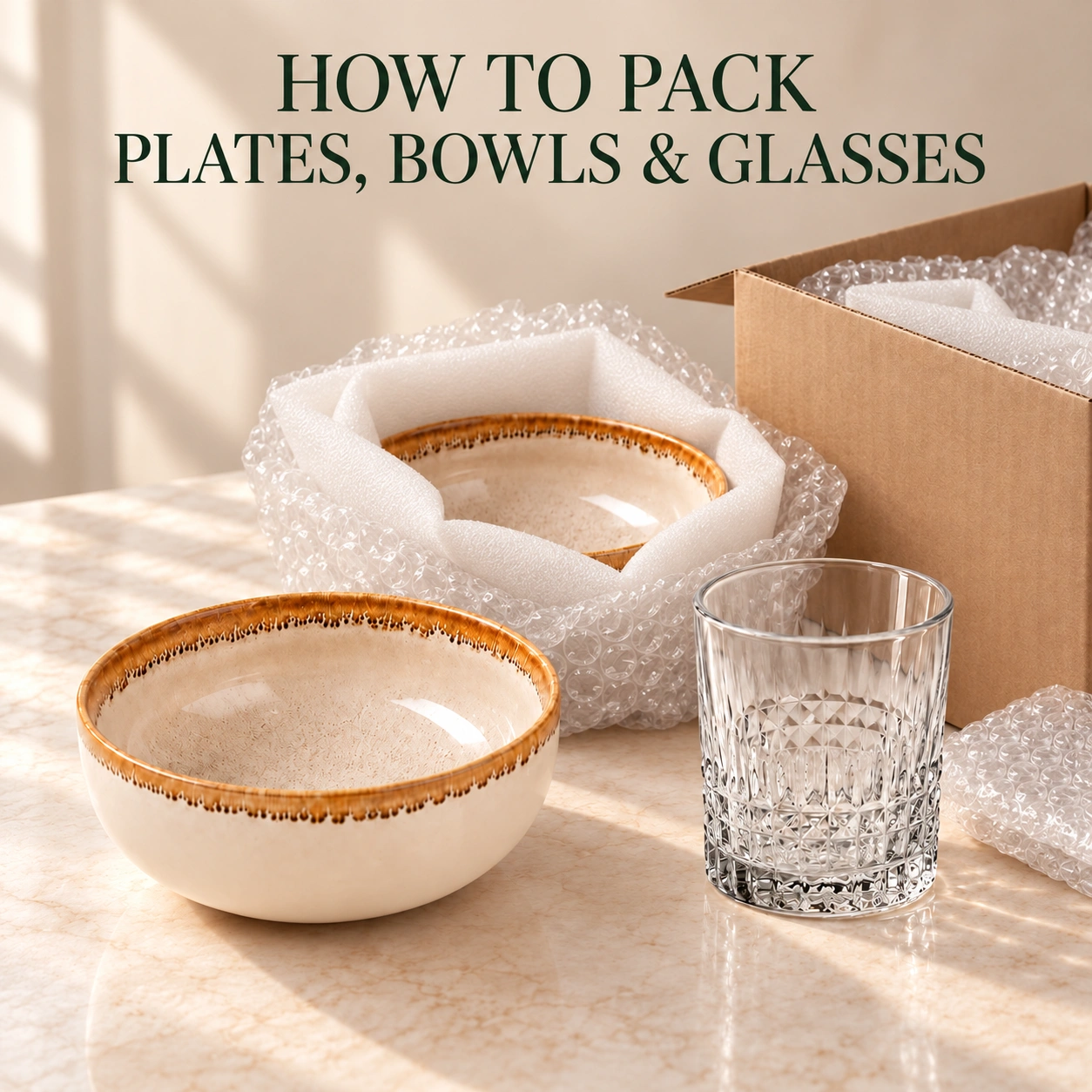
How to Pack Plates, Bowls and Glasses When Moving House
The first meal in a new home rarely happens after everything has been unpacked. More often, it happens between half-open boxes, while you are still deciding where the cups should go. Having a few familiar plates, bowls and glasses ready can make that evening feel easier.
Getting them there takes some care. A dinner plate has a broad, exposed edge. A mug has a handle that can catch against another item. A glass may look sturdy until its rim meets the side of a box. If you are wondering how to pack plates and glasses for moving, the aim is simple: protect each piece individually, keep the contents of each box from shifting and make the essentials easy to find when you arrive.
This guide takes you through the process, from sorting your cupboard to setting the table in your new home.
Start by deciding what needs to travel
Before buying packing materials or opening a box, take everything out of the cupboard and look at what you use.
Separate your dinnerware into plates, small bowls, serving bowls, cups, mugs, everyday glasses and delicate glassware. Count pieces that belong to a set. This is also a good time to identify anything already chipped or cracked so you do not mistake existing damage for something that happened during the move.
Make one more group: the pieces you will need immediately. You may have twelve glasses, but only need two on your first evening. Keeping those two accessible will save you from opening every kitchen box to find a drink.
Choose boxes you can lift comfortably
Dinnerware can make a box heavy faster than it appears. Use sturdy, manageable cartons and reinforce their bases with packing tape. Add cushioning to the bottom before placing any item inside.
You will also need clean packing paper or another suitable wrapping material, extra padding to fill gaps, tape and a marker. Purpose-made dividers can help separate glasses, especially when several are travelling in one box.
A box is ready to close only when its contents are supported on all sides. Wrapping protects individual items; the cushioning around them stops those items from moving into one another.
How to pack ceramic plates for moving
Plates are easy to count and stack in a cupboard. They need a different arrangement for a journey.
Wrap each plate separately, folding the paper across both faces and around the entire rim. If the first sheet leaves part of the edge exposed, add another. Put padding between plates so their glazed surfaces do not rub together.
Well-wrapped plates are often packed upright on their edges, much like records on a shelf, in a suitably sized and padded box. Add cushioning beneath and around the row so it stays supported. Do not leave an upright row loose enough to fall sideways, and do not force extra plates into a box that is already full. Moving professionals commonly recommend this upright arrangement with substantial padding between pieces. Expert packing guidance
Pay attention to the complete rim, including any decorative finish. Nestcase’s beige dinner plates with black rims, for example, are sold as a set of six 25 cm plates. If moving a set, count all six before sealing the box and write the quantity on the label.
How to pack bowls for moving
A bowl’s curved shape can make it look as though it will be safe nested inside another. That depends on how the bowls fit and how much padding sits between them.
Wrap each small bowl or katori individually. If you choose to nest compatible bowls, place cushioning between every piece and check that they separate without resistance. Their rims should not rest directly against each other. Never push one bowl firmly into another to save space.
Serving bowls need room around their wider edges. Protect each bowl, place it securely and fill the gaps around it. Avoid resting a heavy plate or another serving bowl on an exposed rim.
If you are packing dinnerware for moving as a complete set, record its contents before dividing it between boxes. For instance, nestcase’s olive-green 14-piece dinner set contains six dinner plates, six small bowls and two serving bowls. A simple written count makes it easier to check the set when you unpack.
Give cup and mug handles extra attention
A mug handle needs its own protection. Wrap the cup’s body first, then cushion the handle and the space around it. The aim is to stop another item pressing against the handle during transport.
Position wrapped cups so the handles do not carry the weight of neighbouring pieces. Fill any empty space that would let a cup rotate inside the box. A separate cup box, or a well-divided section of a carton, is usually easier to manage than placing mugs among heavy plates.
The same approach applies to a teacup with a smaller handle: protect its shape as it is, without trying to flatten wrapping tightly against the handle.
How to pack glasses safely
For drinking glasses, protect the rim and prevent glass-to-glass contact.
Wrap every glass individually. Cover the outside and rim, and use suitable clean padding for the opening. Place wrapped glasses in a padded box or appropriate divider so they cannot knock against each other. Fill gaps beside and above them before closing the carton.
Do not assume a thick-looking base makes the entire glass equally sturdy. Nestcase’s 300 ml geometric-cut clear glasses, for example, have a distinctive textured appearance, but each glass should still be separated and counted individually when moving.
What about wine glasses and flutes?
Stemware needs closer attention because the bowl, stem, base and rim can be exposed in different ways. Wrap each glass separately and use a suitable divider or dedicated glassware carton when available. Keep heavier tumblers from pressing against it.
If you own a set such as nestcase’s 455 ml crystal wine glasses, check the count before packing and again after unpacking. A single label saying “six wine glasses” is more useful than a box marked only “kitchen.”
Fill every gap before sealing the box
After packing, look down the sides of the box and across its top. Can a plate lean? Can a bowl slide? Could a glass touch its neighbour if the box is lifted? Add clean packing material wherever there is room for movement.
Close the flaps and gently check whether the contents shift. If they do, reopen the box and improve the cushioning. Do not make a carton so heavy or tightly packed that you cannot carry it securely.
Label each box with both its contents and its destination room. “Kitchen — dinner plates — 6 pieces” is clearer than “fragile.” Mark fragile boxes clearly as well, and indicate the intended upright orientation. A label helps people handle the box, while the wrapping and padding protect what is inside.
Pack a separate first-meal box
One of the most useful ways to simplify unpacking kitchen essentials is to prepare for the first meal before the move begins.
Set aside enough plates, bowls, cups and glasses for the people arriving at the new home. Include the cutlery you will need. You might also want a serving bowl if you know you will be sharing a meal. Wrap these pieces properly and put them in one clearly labelled, accessible box.
You do not need to unpack a full dinner set on the first night. A smaller selection lets you eat, have a drink and settle in while the rest of the kitchen waits its turn.
Unpack slowly and check each piece
Place the box on a stable surface before opening it. Remove one wrapped item at a time; do not pull a whole group out together if pieces are fitted closely.
Check plate rims, bowl edges, cup handles and glass rims in good light. Compare the count with the label you wrote while packing. Wash the pieces according to their product care instructions, dry them and then decide where they will live in the new kitchen.
Keep any chipped or cracked item aside for separate assessment. It should not go straight onto the everyday dining shelf simply because the rest of its set arrived safely.
A simple checklist before the boxes leave
| Check | Why it matters |
|---|---|
| Each piece is wrapped individually | Prevents direct contact between surfaces and rims |
| The box has padding underneath and around the contents | Reduces movement during handling |
| Handles, rims and stems are protected | Gives vulnerable areas their own cushioning |
| Empty spaces are filled | Stops items sliding into one another |
| The box is manageable to lift | Makes handling more secure |
| Contents and piece counts are labelled | Makes unpacking and inspection easier |
| First-meal essentials are separate | Gives you usable dinnerware on arrival |
Frequently asked questions
Should plates be packed flat or upright?
Well-wrapped plates are often placed upright on their edges inside a properly cushioned box. They must be supported underneath, between pieces and at both ends of the row. Follow any instructions supplied with a purpose-made dish box.
Can I nest ceramic bowls when moving?
You can nest bowls that fit naturally if each one has adequate padding between it and the next. Do not force bowls together or let their rims touch directly.
How do I pack mugs without breaking the handles?
Wrap each mug and add cushioning around its handle. Position it so another item cannot press on that handle, then fill gaps to stop the mug turning inside the box.
Can regular glasses and wine glasses share a box?
Only if they are securely separated and the heavier glasses cannot press against the stemware. Appropriate dividers or separate boxes make the arrangement easier to check.
How many kitchen items should go in a first-day box?
Pack according to the number of people in your household and what you expect to eat or drink when you arrive. Start with one place setting per person and add only the essentials you will genuinely need before the main kitchen boxes are opened.
Should I wash plates and glasses after unpacking?
Inspect them first, then clean them according to the care guidance for each product before returning them to everyday use.
A new home begins with everyday things
Packing dinnerware takes time because these are the pieces you live with every day. Protecting them carefully means the cup you reach for in the morning and the bowl you use at dinner can become part of your new routine, too.