
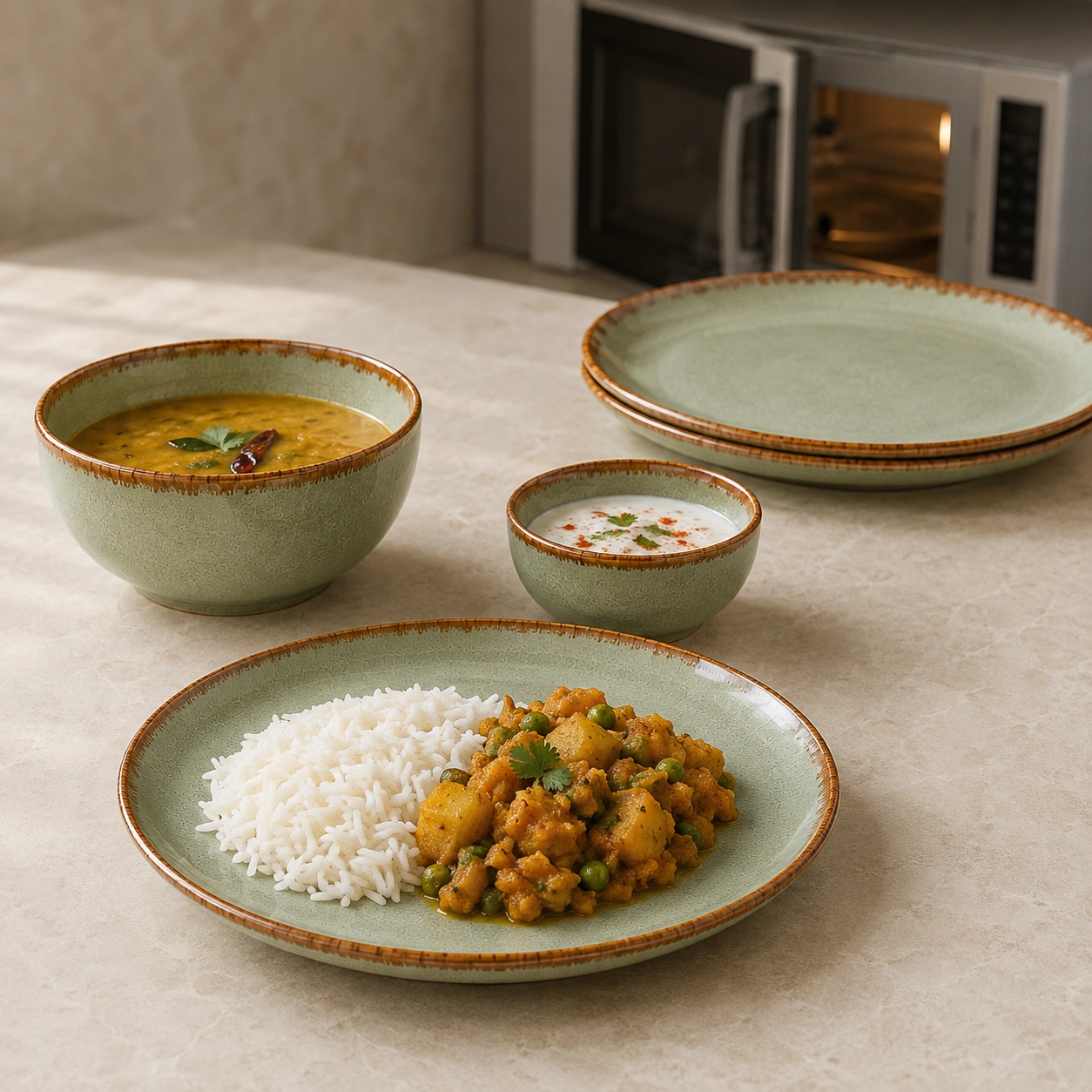
Is Ceramic Dinnerware Microwave-Safe? 8 Checks Before Reheating Food
Ceramic plates and bowls are convenient for serving everyday meals, but is ceramic microwave safe for reheating food? The short answer is: many ceramic, stoneware and porcelain products are suitable for microwave use, but not every piece is. The safest approach is to use only microwave safe ceramic dinnerware that is clearly identified as such by its manufacturer.
Material alone is not enough to decide. Metallic decoration, cracks, unknown handmade finishes and sudden temperature changes can all affect whether a plate or bowl is suitable. Before you reheat dal, rice, curry or leftovers, check the exact product instructions rather than assuming all ceramic behaves in the same way.
Quick answer: are ceramic plates microwave safe?
Are ceramic plates microwave safe? Yes, many are—but only when their label, packaging or product page explicitly confirms microwave suitability. The USDA recommends using utensils labelled for microwave use, while appliance guidance notes that ceramic dishes with metallic paint or inlays should not be placed in a microwave. (USDA, Whirlpool)
Before using a ceramic plate or bowl, confirm all of the following:
- The exact product is labelled microwave-safe.
- It has no gold, silver or other metallic decoration.
- It has no visible cracks, chips or glaze damage.
- It is not antique or made by an unknown manufacturer.
- It has not moved directly from a freezer or very cold surface.
- It fits without obstructing the microwave turntable.
- The food leaves adequate headroom inside the bowl.
- You can remove it safely if the dinnerware becomes hot.
If any of these checks fail, use another verified microwave-safe container.
What does “microwave-safe” actually mean?
A microwave-safe label means the manufacturer identifies that product as suitable for its stated microwave use. It does not mean the plate or bowl will remain cool. Heat from food, liquid and steam can transfer to the ceramic, so handles, rims and bases may still become hot.
It is also important to separate four different care claims:
| Product claim | What it generally confirms | What it does not automatically confirm |
|---|---|---|
| Microwave-safe | Suitability for stated microwave use | Oven, flame or stovetop suitability |
| Dishwasher-safe | Suitability for stated dishwasher cleaning | Microwave or oven suitability |
| Oven-safe | Suitability within specified oven conditions | Microwave or stovetop suitability |
| Freezer-safe | Suitability for stated freezer use | Direct freezer-to-microwave use |
Do not treat these labels as interchangeable. A microwave safe dinner set is not automatically oven-safe, and a dishwasher-safe bowl is not automatically suitable for microwave reheating.
Ceramic, stoneware and porcelain: what is the difference?
Ceramic is the broad material family. Stoneware and porcelain are both types of ceramic, but they are produced differently and may have different finishes, absorption levels and care instructions.
Is ceramic microwave safe?
When shoppers ask is ceramic microwave safe, the correct answer depends on the exact product rather than the material name alone. Commercial ceramic plates, mugs and bowls are often designed for microwave use, but exceptions include pieces with metallic decoration, certain handmade pottery and products without verified care information.
Can stoneware go in microwave ovens?
Can stoneware go in microwave ovens? Many stoneware products can, provided the manufacturer identifies them as microwave-safe and the piece is undamaged. For example, selected nestcase stoneware listings explicitly state microwave suitability, but that claim must still be checked on the individual product page.
Is porcelain microwave-safe?
Many porcelain products are suitable for microwave use, but metallic trims or unverified decoration can make an otherwise suitable piece inappropriate. The same label-first rule applies to porcelain, stoneware and other ceramic dinnerware.
Eight checks before microwaving ceramic dinnerware
1. Check the label or exact product listing
Look for a microwave safe symbol or a written microwave-safe claim on the packaging, care card or exact product page. Do not assume that every product from one brand—or even every piece in one colour collection—has identical care requirements.
If the product information is unavailable, do not conduct an improvised microwave experiment. Use verified microwave safe ceramic dinnerware instead.
2. Check the exact SKU, not only the collection name
Two plates can appear nearly identical while using different decoration or finishes. Verify the individual SKU, supplied care instructions and current product listing. This is particularly important when duplicate marketplace listings contain inconsistent information.
When buying a microwave safe dinner set, confirm whether the claim covers all supplied components: dinner plates, quarter plates, small bowls and serving bowls.
3. Avoid metallic rims, paint and inlays
The FDA states that metal cookware and aluminium foil generally should not be used in a microwave because metal reflects microwave energy and may cause uneven cooking or damage. Appliance guidance similarly advises against ceramic dinnerware with metallic paint or inlays. (FDA, Whirlpool)
Searches for gold rim plates microwave safety are common because a thin decorative line may not look like substantial metal. Do not judge by appearance. If the manufacturer does not explicitly approve microwave use, keep gold-rimmed or metallic-finished dinnerware out of the microwave.
4. Inspect for cracks, chips and glaze damage
Check the rim, base, handle and glazed surface before each use. A damaged piece may weaken further when heated and may also be difficult to clean thoroughly. Retire noticeably cracked or chipped dinnerware from microwave use and follow the manufacturer’s replacement or disposal guidance.
This inspection is an essential part of ceramic bowl microwave safety, especially for bowls used frequently for hot curries, soup or reheated leftovers.
5. Avoid sudden temperature changes
Do not transfer ceramic dinnerware directly from a freezer or very cold surface into a hot microwave unless the manufacturer specifically approves that use. Similarly, do not place a very hot plate onto a cold, wet surface or rinse it immediately with cold water.
Allowing temperature to change gradually can reduce thermal stress. “Microwave-safe” should never be interpreted as permission for unrestricted temperature changes.
6. Check size, rotation and headroom
The plate or bowl must fit comfortably inside the appliance without touching the walls or preventing the turntable from rotating. For liquid foods, leave adequate space below the rim so bubbles, steam or stirring do not cause spills.
This is one reason microwave safe bowls should be selected by both verified care information and practical capacity—not only by colour or appearance.
7. Follow the microwave manufacturer’s instructions
Microwave ovens differ by wattage, functions and approved cookware. Check your appliance manual, especially when using grill, convection or combination modes. A dish approved for conventional microwave reheating may not be approved for every combination setting.
The FDA also advises following the container guidance provided with the microwave oven. (FDA)
8. Handle the dinnerware as if it may be hot
Even microwave safe dinner plates and bowls can absorb heat from food. Steam can also make rims and handles unexpectedly hot. Pause before lifting, keep your face away from rising steam and use suitable hand protection when needed.
Do not let children remove hot dinnerware without appropriate adult supervision.
Why does microwave-safe ceramic dinnerware still get hot?
A microwave mainly heats the food and liquid, but that heat then transfers to the surrounding plate or bowl. A dense curry, hot oil, sugar syrup or boiling liquid can make the ceramic feel significantly hotter than expected.
Some ceramic constructions may also warm more than others. That does not by itself prove that the product is unsafe, but unusual overheating, visible damage, sparking or unfamiliar sounds are reasons to stop the microwave and consult the product and appliance instructions.
The practical rule is simple: stoneware microwave safe does not mean stoneware remains cool, and ceramic microwave-safe does not mean bare-hand safe immediately after heating.
How to reheat food in ceramic bowls
When you reheat food in ceramic bowls, use only bowls whose exact product information confirms microwave suitability. Arrange food evenly, avoid overfilling and use a cover identified as microwave-safe when appropriate.
Dal, curry and soup
Choose a deep bowl with headroom below the rim. Stir carefully during reheating where appropriate so the temperature is distributed more evenly. Open covers away from your face to release steam safely.
Rice
Spread rice evenly rather than compressing it into one dense mound. Follow an established food-safety method for reheating leftovers, including appropriate storage and heating temperatures. USDA guidance recommends using covered microwave-safe glass or ceramic dishes for reheating food. (USDA)
Sabzi and one-plate meals
Arrange the food so thicker or denser portions are not concentrated in one place. Use microwave safe dinner plates with sufficient usable surface area and stop periodically to check the food where necessary.
Small portions, dips and desserts
Compact microwave safe bowls may be useful for controlled portions, but always leave headroom for foods that bubble, expand or release steam.
Because appliance wattage, food quantity and starting temperature vary, this guide does not provide one universal reheating time.
Can ceramic plates go in microwave ovens if they have a black or coloured rim?
Can ceramic plates go in microwave ovens when they have a decorative rim? A coloured rim is not automatically metallic. The deciding factor is the verified product specification—not whether the rim appears black, brown, blue or gold.
A reactive-glaze plate with a coloured ceramic rim may be labelled microwave-safe, while a visually similar plate with metallic paint may not be suitable. Check the exact listing and care card every time.
The same caution applies to the gold rim plates microwave question: unless the manufacturer clearly confirms microwave use, avoid putting metallic-rim dinnerware in the appliance.
Can stoneware go in microwave ovens every day?
If you are wondering can stoneware go in microwave ovens for daily reheating, begin with the manufacturer’s care instructions. Regular use still requires basic inspection, appropriate food quantity, gradual temperature changes and safe handling.
The phrase stoneware microwave safe describes suitability under the stated conditions; it does not remove the need to inspect the product or follow the microwave manual.
When should ceramic dinnerware stay out of the microwave?
Do not microwave the dinnerware when:
If you cannot find a microwave safe symbol or written care instruction, use a clearly labelled alternative.
Microwave-safe nestcase dinnerware to consider
The following nestcase product pages currently state that the products are microwave-safe. Recheck the live product listing, supplied packaging and care instructions before purchase or use.
Reactive Blue 14-Piece Stoneware Dinner Set
The nestcase Reactive Blue 14-Piece Stoneware Dinner Set includes six dinner plates, six small bowls and two serving bowls. Its product listing identifies the set as microwave- and dishwasher-safe, making it a practical microwave safe dinner set for coordinated family dining.
Reactive Blue Dinner Plates—Set of 6
The nestcase Reactive Blue Dinner Plates have a 25 cm diameter and a listing that identifies them as microwave-safe. These microwave safe dinner plates can support everyday meals when used according to the care instructions.
Beige with Black Rim Small Bowls—Set of 6
The nestcase Beige with Black Rim Small Bowls provide a 220 ml capacity. The product page lists them as microwave-safe, making them relevant for shoppers comparing compact microwave safe bowls for dal, chutney, dessert or other small portions.
Blue and White Striped Serving Bowls—Set of 2
The nestcase Blue and White Striped Serving Bowls offer a 750 ml capacity each and are currently described as microwave-safe. Their depth can be useful when you need to reheat food in ceramic bowls while retaining sensible headroom.
Olive Green Dinner Plates—Set of 6
The nestcase Olive Green Dinner Plates are 25 cm stoneware plates whose listing currently states microwave suitability. As with all microwave safe ceramic dinnerware, the care guidance should be checked again before use.
You can also compare the full nestcase Dinner Sets collection and Bowls & Platters collection, but verify microwave suitability separately for each SKU.
Common microwave mistakes to avoid
Avoiding these mistakes is more useful than relying on a generic answer to “are ceramic plates microwave safe?” The exact plate, condition and intended appliance setting all matter.
Final ceramic dinnerware microwave checklist
Before pressing Start, ask:
If every answer is satisfactory, follow the product and microwave instructions. If any answer is uncertain, choose another verified container.
Frequently asked questions
1. Is ceramic microwave safe?
Many ceramic products are microwave-safe, but not all of them. To answer is ceramic microwave safe for a particular plate or bowl, check the exact manufacturer’s label, packaging or product page. Avoid metallic decoration and unverified or damaged pieces.
2. Are ceramic plates microwave safe?
Are ceramic plates microwave safe? They can be when explicitly labelled for microwave use. The fact that a plate is ceramic does not, by itself, confirm microwave suitability.
3. Can ceramic plates go in microwave ovens?
Can ceramic plates go in microwave ovens? Yes, when the exact plate is marked microwave-safe, has no prohibited metallic decoration, is undamaged and fits the appliance correctly.
4. Can stoneware go in microwave ovens?
Can stoneware go in microwave ovens? Many stoneware products can, but you should use only stoneware that the manufacturer identifies as microwave-safe. Follow its care instructions and avoid sudden temperature changes.
5. What does stoneware microwave safe mean?
Stoneware microwave safe means the manufacturer has identified that stoneware product as suitable for stated microwave use. It does not mean it is automatically oven-safe, flame-safe or cool to touch after heating.
6. Why does a microwave-safe ceramic bowl become hot?
Hot food, liquid and steam transfer heat to the bowl. The bowl can therefore become hot even when it is suitable for microwave use. Safe handling is an important part of ceramic bowl microwave safety.
7. Can plates with gold rims be microwaved?
Searches for gold rim plates microwave safety should be answered cautiously: metallic decoration generally should not go in a microwave. Use the plate only if the manufacturer explicitly confirms that exact product is suitable.
8. What does a microwave safe symbol look like?
The microwave safe symbol varies by manufacturer and market. It may use wavy lines, a microwave icon or written wording. Consult the product packaging or manufacturer rather than relying on the icon’s appearance alone.
9. Does dishwasher-safe mean microwave-safe?
No. Dishwasher-safe describes a cleaning method, while microwave-safe describes suitability for microwave use. Check both claims independently.
10. Can a cracked ceramic bowl go in the microwave?
Do not microwave noticeably cracked, chipped or glaze-damaged ceramic dinnerware. Replace it or follow the manufacturer’s guidance.
11. Can ceramic go directly from the freezer to the microwave?
Not unless the manufacturer specifically confirms that use. A sudden temperature change can stress ceramic dinnerware, even when it is otherwise microwave-safe.
12. How should I reheat food in ceramic bowls?
To reheat food in ceramic bowls, use a verified microwave-safe bowl, avoid overfilling, arrange food evenly, use a suitable cover when appropriate and handle the bowl carefully after heating.
Conclusion
So, is ceramic microwave safe? It can be—but the correct answer always comes from the exact product instructions. Look for clear microwave-safe labelling, avoid metallic decoration, inspect for damage, prevent sudden temperature changes and handle heated dinnerware carefully.
When shopping for microwave safe ceramic dinnerware, compare the complete care information instead of relying only on colour, material or product photography. Explore verified nestcase plates, bowls and dinner sets, then choose the pieces that suit your food portions, appliance size and everyday routine.
CTA: Explore nestcase dinnerware and verify the dimensions, supplied quantity and care instructions of each product before use.