
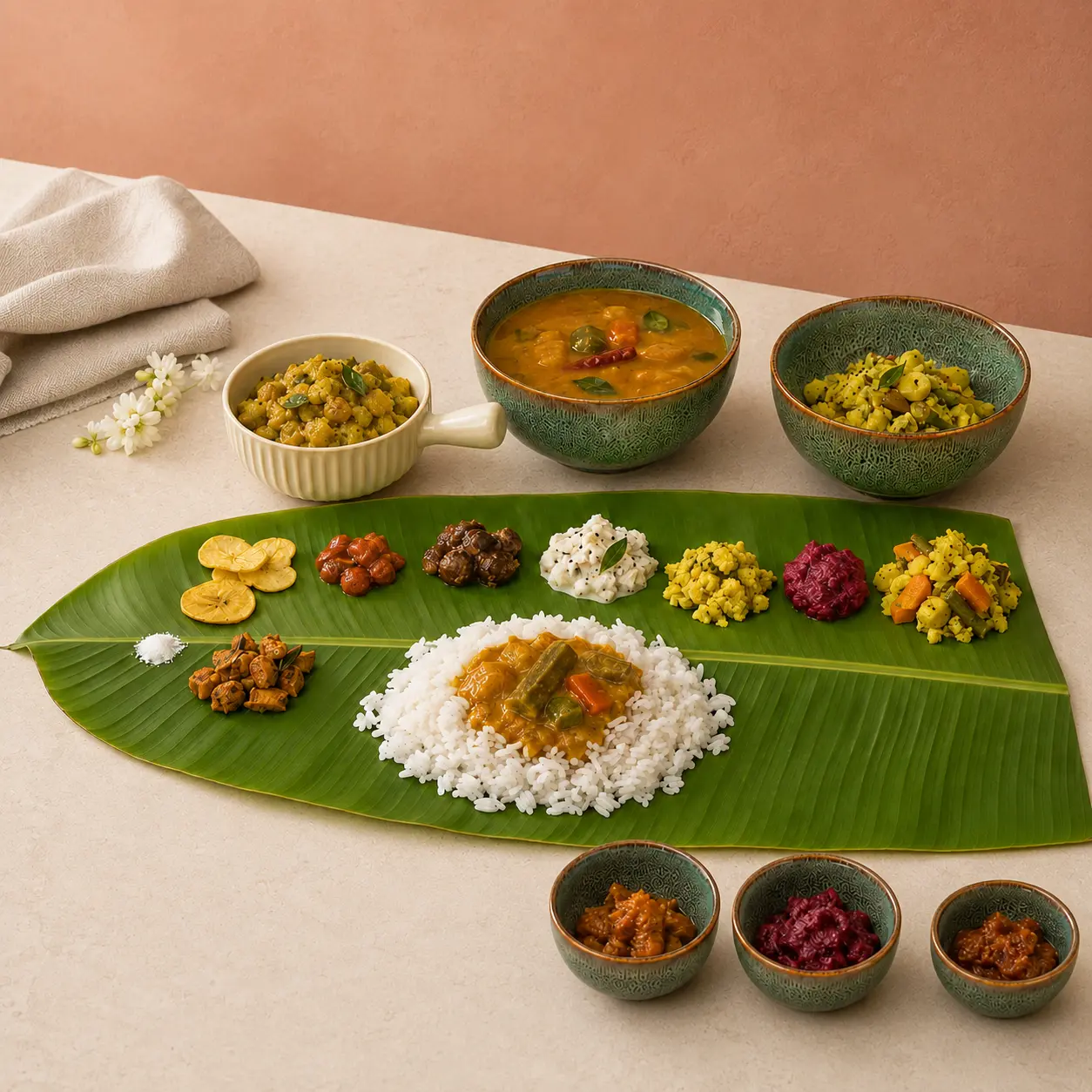
An Onam Sadya is generous by design: many flavours, several courses and a table that brings everyone together. Yet hosting the feast at home can feel complicated when you are deciding which way the banana leaf should face, where each dish belongs and how to serve multiple courses without crowding the table.
This guide explains a commonly followed Onam Sadya serving order, a practical Onam Sadya banana leaf arrangement and an organised tableware plan for four or six guests. Customs are not identical across Kerala—or even across families—so use the framework as a starting point and follow your household’s tradition whenever it differs.
Kerala Tourism describes Thiruvonam as the most significant day of the ten-day celebration and highlights the grand Onasadya feast as one of its central traditions. In 2026, Kerala Tourism lists Thiruvonam on 26 August. Read Kerala Tourism’s Thiruvonam overview.
Quick guide: the basic Onam Sadya arrangement
THE SHORT ANSWER Place the banana leaf horizontally with its narrow end toward the diner’s left. Keep accompaniments and vegetable dishes across the upper half, and reserve the lower centre for rice and the curries served with it. Serve in courses so the leaf and table never feel overloaded. |
Set one clean, food-safe banana leaf for each guest, with the tapered end pointing left.
Place small portions of chips, pickles, condiments and vegetable accompaniments across the upper section.
Leave the broad lower area clear until guests are seated, then serve rice there.
Begin the rice courses with parippu and ghee where customary, followed by sambar and the household’s later savoury courses.
Serve payasam at the stage followed by your family; its timing and serving style can vary.
Keep refill vessels on a nearby sideboard rather than forcing every pot and bowl onto the dining table.
What is an Onam Sadya?
Sadya means a feast, and Onasadya is the festive vegetarian meal associated with Onam. It is traditionally served on a banana leaf and brings together rice, curries, vegetable preparations, pickles, chips, pappadam and payasam. The exact menu can be compact at home or much more elaborate for a large celebration.
The experience is not simply about counting dishes. Its rhythm comes from contrast: crisp and soft, sour and sweet, mild and spicy, dry accompaniments and flowing curries. Thoughtful placement makes those elements easier to serve and enjoy.
How to place the banana leaf for Sadya
For the most widely described banana leaf placement for Sadya, lay the leaf horizontally so the narrow or tapered end points toward the diner’s left and the broader end extends to the right. The upper edge holds smaller accompaniments; the lower half, closer to the diner, remains available for rice and curries.
Prepare each leaf before setting the table
Use leaves intended for food service. Rinse or wipe them carefully with clean water, allow excess water to drain and inspect each leaf for damage before placing it. Set the leaves shortly before the meal so the table remains fresh and orderly.
Allow enough personal space
A banana leaf needs more width than a standard place setting. Position chairs first, then test whether every guest can reach the rice area comfortably without touching the neighbouring leaf. If the dining table is small, serve in two sittings or reduce table décor rather than folding or overlapping the leaves.
If banana leaves are unavailable
A broad ceramic dinner plate can be a practical substitute for an at-home meal, but it should be described as an alternative—not the traditional Sadya presentation. Use small bowls only when they help guests manage liquid dishes or when the household prefers them.
Where should the dishes go on an Onam Sadya banana leaf?
A useful Onam Sadya dishes placement plan works by zones. It keeps small, strong-flavoured accompaniments away from the main rice area and gives the server a predictable path around the leaf.
| Leaf zone | Typical food group | Hosting note |
| Upper left | Salt, pickles, inji-based condiments and small portions of chips | Keep intense flavours in small, distinct portions. |
| Upper middle | Pachadi, kichadi and selected vegetable preparations | Leave a little separation so wet dishes do not run together. |
| Upper right | Avial, thoran, olan, erissery or the family’s other sides | Arrange according to the household’s preferred sequence. |
| Lower centre | Rice | Keep this generous area empty until the rice course begins. |
| Lower area during courses | Parippu and ghee, sambar and later curries | Serve one course at a time and add rice only as needed. |
| Separate or designated area | Payasam, banana or additional pappadam | Follow family custom; payasam may be served on the leaf or in a small bowl. |
This arrangement reflects a common pattern, not a universal diagram. Dish names, exact left-to-right positions and the timing of payasam can change by region and family. The most respectful approach is to confirm the plan with the person whose tradition the household follows.
Onam Sadya serving order: a practical course-by-course guide
The following Sadya serving sequence is designed for a manageable home lunch. It follows a widely recognised progression while leaving room for household variations.
Set water and the banana leaves. Seat guests only after the leaves, water glasses and service path are ready.
Serve the dry accompaniments first. Add salt, chips, pappadam, banana and the family’s chosen pickles or condiments in small portions.
Place the vegetable side dishes. Arrange preparations such as thoran, avial, olan, erissery, pachadi or kichadi across the upper half without mixing them together.
Serve rice in the lower centre. Start with a moderate portion so the diner has space to mix each course comfortably.
Begin with parippu and ghee where customary. Offer more rice after the course instead of placing an oversized mound at the start.
Continue with sambar. Refill only when guests are ready, and keep a dedicated ladle or spoon with the serving vessel.
Move to later savoury courses. Pulissery, kalan, rasam or moru may follow in different sequences depending on the family and region.
Serve payasam according to household tradition. It may be poured onto a clear area of the leaf, enjoyed with banana or pappadam, or served in a small bowl for convenience.
Finish with unhurried clearing. Let every guest complete the meal before removing service pieces or resetting the table.
A published serving guide from The Indian Express similarly notes the left-facing narrow end, upper-half accompaniments, lower-half rice and a course-based progression—and explicitly recognises regional variation. See the referenced serving guide.
How to organise serving bowls and tableware
A calm Onam feast table setup begins away from the dining table. Create a small service station and group the vessels by function before guests arrive.
Assign one vessel and spoon to every dish
Place the serving spoon beside its matching bowl during preparation and keep the pair together throughout lunch. This prevents flavours from mixing and allows another family member to help without repeatedly asking which spoon belongs where.
Match the bowl to the food quantity
Use small bowls for pickles, inji preparations and other limited-quantity accompaniments. Medium serving bowls can hold vegetable sides or smaller refills. Rice, sambar and frequently replenished curries may require larger vessels based on the number of guests. Do not assume that one bowl size works for every dish.
Use 750 ml bowls selectively
A pair of 750 ml ceramic serving bowls can work well for selected shared preparations or organised refills. For six guests, check the recipe yield before deciding whether one bowl is sufficient; a frequently served curry may need a larger vessel or a second refill kept warm nearby.
Explore: Floral White Ceramic Serving Bowls—Set of 2, 750 ml each | Bowls & Platters collection
How to serve four or six guests without crowding the table
The simplest way to host Onam Sadya at home is to separate dining from refilling. The leaves and water belong at the table; most refill vessels belong on a nearby counter, trolley or sideboard.
For four guests, keep only two or three current-course bowls on the table and hold the remaining vessels at the service station.
For six guests, assign one person to serve rice and curries while another handles accompaniments and water.
Arrange the service station in the same order as the meal: dry accompaniments first, vegetable sides next, rice and curries after them, and payasam last.
Keep hot vessels on suitable heat-safe surfaces and away from leaf edges, children and narrow walkways.
Use one tray for small condiment bowls so they can be moved together without cluttering the table.
Keep reserve portions off the main table and refill smaller serving bowls when required.
A modern Onam table that still respects tradition
The food and banana leaf should remain the visual focus. A minimal palette of natural green, warm white, pale wood and restrained brass tones creates a festive setting without competing with the Sadya.
Choose one low floral element rather than a tall centrepiece. Keep lamps or candles away from the service route and leaves. Use plain water glasses and unobtrusive napkins. If ceramic serving bowls are included, repeat one coordinated colour or pattern instead of mixing several unrelated designs.
Most importantly, style should support service. Guests need enough elbow room, servers need an open path and every hot dish needs a safe place to rest. A beautiful Onam lunch serving arrangement is one that feels generous and comfortable—not crowded.
Common Onam Sadya hosting mistakes to avoid
Placing the banana leaf with the tapered end facing the wrong direction for the tradition being followed.
Filling the lower half with side dishes and leaving too little space for rice.
Serving large portions of every accompaniment before guests know what they prefer.
Putting every cooking vessel on a small dining table at the same time.
Using the same spoon for multiple curries, pickles or desserts.
Treating one dish order as the only authentic practice across Kerala.
Using decorative objects that obstruct the server’s path or touch the food.
Publishing an AI-generated placement diagram without checking its foods, leaf direction and product shapes.
Final Onam Sadya hosting checklist
☐ Guest count and number of sittings confirmed
☐ Clean banana leaf for every guest, plus a few spares
☐ Tapered end positioned according to the family’s custom
☐ Dish list grouped into accompaniments, vegetable sides, rice courses and dessert
☐ Separate serving spoon or ladle assigned to each dish
☐ Table kept clear for leaves, water and the current course
☐ Refill station organised in serving order
☐ Hot vessels placed safely on suitable surfaces
☐ Payasam serving method decided in advance
Frequently asked questions
What is the correct Onam Sadya serving order?
A commonly followed Onam Sadya serving order begins with dry accompaniments and vegetable side dishes, followed by rice with parippu and ghee, sambar, later savoury courses and payasam. The exact progression varies by family and region.
Which direction should the banana leaf face for Sadya?
The widely followed convention is to place the leaf horizontally with its narrow or tapered end toward the diner’s left and the broad end toward the right.
Where should rice be placed on the banana leaf?
Rice is generally served in the lower central area of the leaf, closer to the diner. The upper half is reserved for smaller accompaniments and vegetable preparations.
Where are pickles and banana chips placed?
Pickles, chips and other small accompaniments are usually arranged in small portions along the upper half, often beginning toward the left. Exact positions can differ across households.
How many dishes are served in an Onam Sadya?
There is no single required number for every home. A Sadya may include a focused selection or a much larger spread depending on family tradition, region, occasion and the number of cooks.
Can Onam Sadya be served on ceramic plates?
A ceramic plate can be used when banana leaves are unavailable or impractical, but it is an at-home alternative rather than the traditional presentation.
When is payasam served during Sadya?
Payasam is served during the sweet stage of the meal, but its exact position in the sequence and whether it is served on the leaf or in a bowl vary by household.
How should serving bowls be arranged for six guests?
Group bowls by course on a nearby sideboard, keep one spoon with each dish and bring only the current course to the table. Refill smaller bowls rather than crowding the table with every vessel.
Can the Sadya serving sequence vary between families?
Yes. Dish names, placement and course order can differ by family, community and region. A home guide should acknowledge those differences and follow the host family’s custom.
How can I arrange an Onam Sadya on a small dining table?
Remove tall décor, keep refill vessels on a nearby counter, place only current-course bowls at the table and consider serving guests in two sittings if the banana leaves overlap.
Bring calm to a generous Onam feast
A thoughtful Onam Sadya at home does not require a restaurant-sized dining room or every possible dish. It requires a clear banana leaf placement, a serving sequence that the household recognises and tableware arranged around the way the meal is actually served.
Plan the Onam Sadya serving order before guests arrive, keep the upper half of the leaf organised, protect the rice area and move through each course without rushing. Then use coordinated nestcase serving bowls only where they make curries, vegetables and refills easier to manage.
CTA: Explore nestcase bowls and platters for a considered festive serving setup—after checking the capacity, supplied quantity and current availability of each product.