
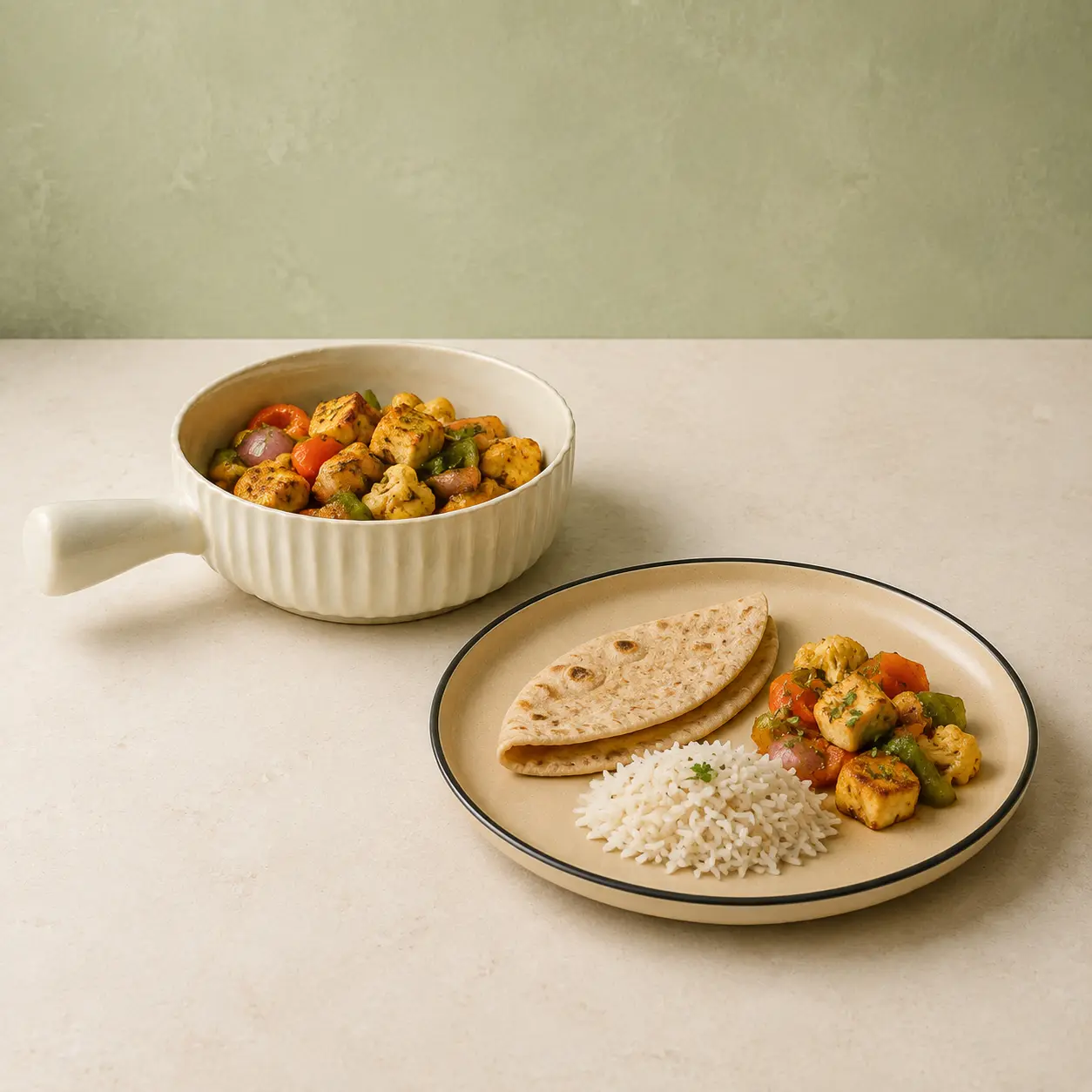
Serving Platter vs Dinner Plate: What’s the Difference?
A dinner plate is designed primarily for an individual meal, while a serving platter is used to arrange and present food that several people will share. Dinner plates are generally placed at individual seats, whereas serving platters are positioned at the center or side of the table.
That is the simplest answer to the serving platter vs dinner plate question. However, choosing between them also depends on the food, number of guests, available table space and whether serving spoons or tongs are required.
Understanding the difference between a plate and platter can help you build a more practical tableware collection and avoid buying pieces that look attractive but do not suit the way you serve food.
Serving Platter vs Dinner Plate: Quick Comparison
| Feature | Dinner plate | Serving platter |
|---|---|---|
| Main purpose | Holds an individual meal | Presents food for sharing |
| Table placement | One at each seat | Centre or side of the table |
| Common shape | Usually round | Often oval, rectangular or elongated |
| Suitable foods | Roti, sabzi, rice, pasta and personal portions | Snacks, starters, fruit, sweets and shared dishes |
| Serving utensils | Personal cutlery | Tongs, cake servers or serving spoons |
| Quantity required | Usually one per guest | Usually one or two per shared course |
| Storage requirement | Stacks with similar plates | May need wider cabinet space |
These are general differences rather than fixed rules. Dinner plates and serving platters are available in many shapes and sizes, so the exact product specifications should always be checked before purchasing.
What Is a Dinner Plate?
A dinner plate is a piece of tableware intended to hold one person’s main meal. It normally provides enough room for a combination of foods while remaining comfortable to handle and use at the dining table.
A suitable dinner plate for Indian meals may hold roti, sabzi, rice and dry accompaniments, with dal, curry or curd served separately in small bowls. It can also be used for pasta, noodles, breakfast dishes and other individual servings.
Consider the usable eating surface
The overall diameter does not tell you everything about a dinner plate. A wide or raised rim can reduce the usable eating area in the center.
Before buying dinner plates online, check:
A 25 cm plate may be suitable for many everyday meals, but the correct size depends on your usual portions and whether curries are placed directly on the plate or served in separate bowls.
Dinner plates work best for individual portions
A dinner plate helps each person organise their meal according to their preferences. It provides a defined personal serving area and reduces the need to eat directly from a shared dish.
For a coordinated table for six, consider the Beige Dinner Plates with Black Rims—Set of 6. Their neutral colour can support everyday meals as well as restrained hosting arrangements.
Suggested product-image placement: Insert a lifestyle photograph of one beige dinner plate holding a realistic individual Indian meal. Keep the rim visible and place the remaining five plates neatly in the background.
What Is a Serving Platter?
A serving platter is a broad piece of serveware used to arrange and present shared food. It is usually larger or more elongated than an individual plate, allowing several portions to be displayed together.
If you are asking what is a serving platter used for, think of foods such as:
A serving platter for guests can make shared food easier to see and access while creating a clear centerpiece for the table.
Why choose an oval serving platter?
An oval serving platter provides an elongated surface that can suit food arranged in rows or groups. It works particularly well for kebabs, sandwiches, fruit, mithai and other foods that benefit from a longer presentation area.
Its shape may also fit the center of a rectangular dining table more efficiently than a large round plate. However, an oval serving platter can require additional cabinet width, so its measurements should be checked before purchasing.
The Large Beige Ceramic Oval Serving Platter offers a neutral base for presenting colourful appetisers, snacks and desserts.
Suggested product-image placement: Insert a top-down image of the exact beige oval platter holding neatly spaced kebabs, sandwiches or colourful dry snacks. Do not overcrowd the surface.
Seven Differences Between a Serving Platter and Dinner Plate
The most important differences extend beyond size.
1. Individual meal versus shared food
A dinner plate normally belongs to one diner. A serving platter holds food that several guests can take from during the meal.
This difference determines the quantity required. You may need six dinner plates for six guests but only one or two platters for each shared course.
2. Eating versus presentation
Dinner plates must provide a comfortable surface for cutting, scooping and combining food. Platters prioritise presentation, visibility and access.
A ceramic serving platter can frame appetisers attractively, but it may feel inconvenient as an everyday personal plate if it is too long, heavy or difficult to position.
3. Shape
Dinner plates are commonly round because the form supports individual place settings. Serving platters may be oval, rectangular, round or irregular.
Longer forms can help hosts arrange repeated portions—such as kebabs or sandwiches—without piling them on top of one another.
4. Surface area
A platter generally provides more shared presentation space. That space can also accommodate garnishes and serving utensils.
A dinner plate needs enough room for one complete portion without occupying excessive space at every place setting.
5. Rim and depth
Some dinner plates are almost flat, while others feature a raised rim that helps contain rice, gravies or sauces.
Platters also vary considerably. A shallow platter may work for dry snacks, while food containing sauce requires adequate depth. Always confirm the intended use and construction of the exact product.
6. Serving-utensil space
A platter may need room for tongs, a cake server or a serving spoon. Food should not be packed so tightly that guests cannot take a portion neatly.
Personal cutlery, by contrast, usually remains beside the dinner plate rather than on it.
7. Storage footprint
Dinner plates can usually be stacked with other plates of a similar diameter. Large or elongated platters may require a wider shelf, vertical organiser or separate storage position.
Measure your cabinet before choosing a large ceramic serving platter, particularly if the cabinet has narrow doors or fixed internal dividers.
Which Foods Belong on a Dinner Plate?
A dinner plate is usually the better option for:
A good dinner plate for Indian meals should provide enough room for the main components without forcing food onto the rim.
If you prefer pattern-led tableware, the Blue Moroccan Dinner Plates—Set of 6 can add character to individual place settings. Keep food portions restrained enough to leave part of the decorative pattern visible.
Which Foods Belong on a Serving Platter?
A serving platter is usually more practical for:
When choosing a platter for snacks, consider how guests will take the food. Finger foods may only need a shallow surface, while appetisers served with chutney might require separate bowls or a platter with appropriate depth.
A platter for snacks should also leave enough open space for tongs or serving spoons. Overcrowding makes the food harder to access and can make an otherwise attractive presentation feel untidy.
Serving Plate vs Dinner Plate: Can One Replace the Other?
A large serving plate can technically be used for an individual meal, but it may not be the most comfortable choice. It could occupy too much table space or provide more surface area than the diner needs.
Likewise, an ordinary dinner plate can hold shared snacks for two people, but it may become crowded when serving a larger group.
When comparing a serving plate vs dinner plate, begin with the intended purpose:
The best tableware is not necessarily the largest option. It is the piece that suits the food, number of guests and serving method.
Serving Platter vs Tray vs Charger Plate
These products may look similar in photographs, but their functions are different.
Serving platter
A serving platter presents food that guests will share. It may be placed in the centre of the table or passed between diners.
Serving tray
A tray is primarily used to carry or group several items, such as cups, glasses, bowls or plates. Not every tray is intended for direct contact with food.
Charger plate
A charger plate is a decorative base positioned underneath dinnerware. It adds colour or structure to a formal place setting but is not automatically suitable for serving food directly.
Check the product description carefully rather than assuming that every large flat surface can be used in the same way.
How Many Serving Platters Do You Need for Six Guests?
There is no universal number because the answer depends on the menu. A practical starting point for six guests is:
If the menu includes several starters, two smaller platters may be easier to position than one oversized platter. For a compact dining table, keep refill portions on a sideboard and replenish the platter when necessary.
A serving platter for guests should improve access rather than crowd the table.
How to Choose a Serving Platter
Use this checklist when learning how to choose a serving platter for your home:
- List the foods you expect to serve.
- Decide whether the food is dry, moist or sauce-based.
- Check the platter’s length, width and rim depth.
- Measure the available cabinet space.
- Measure the usable center of your dining table.
- Leave room for tongs or serving spoons.
- Confirm the product’s food-use and care information.
- Check whether the supplied quantity is one platter or a set.
- Consider the weight when filled.
- Choose a colour that provides contrast with the food you commonly serve.
A neutral platter can support colourful Indian snacks, while a patterned platter may work best with simpler food presentation.
How to Choose Dinner Plates
Before choosing dinner plates, consider:
For a warm, understated table, consider the Olive Green Dinner Plates—Set of 6. The reactive glaze can complement neutral linen, natural wood and other muted table accessories.
Common Mistakes When Buying Platters and Plates
Choosing only from photographs
Product photography may not communicate true scale. Always read the listed dimensions.
Assuming bigger is always better
A very large platter can overwhelm a small table and become difficult to store.
Ignoring usable surface area
Raised or wide rims may reduce the space available for food.
Confusing a platter with a tray
A tray may be designed to carry tableware rather than hold food directly.
Overcrowding the platter
Food needs breathing room for attractive presentation and convenient serving.
Forgetting the serving utensil
A platter filled edge to edge leaves no comfortable place for tongs or a serving spoon.
Ignoring care instructions
Do not assume that every ceramic product has identical microwave, dishwasher or temperature-safety instructions. Check the exact listing or packaging.
Buying the wrong quantity
Confirm whether the listing includes a single platter, a pair or a complete plate set.
Final Verdict: Do You Need a Platter or Dinner Plates?
Choose dinner plates when you need individual tableware for complete meals. Choose a serving platter when food will be shared and benefits from a broader presentation surface.
For most households, these products complement one another rather than compete. A practical setup for six people may include six dinner plates, one platter for starters and another for snacks, bread or desserts.
The final serving platter vs dinner plate decision should consider the food, number of guests, serving utensils, table space and cabinet measurements—not appearance alone.
Explore the nestcase Bowls and Platters collection and compare it with nestcase dinner plates before building a coordinated tableware collection.
Frequently Asked Questions
What is the difference between a dinner plate and a serving platter?
A dinner plate holds an individual meal and is normally placed at one person’s seat. A serving platter holds food that several people share and is generally placed in the center or at the side of the table.
Can a serving platter be used as a dinner plate?
It can be used as one, but a large or elongated platter may occupy too much space and feel uncomfortable for an individual meal. A properly sized dinner plate is usually more practical.
What foods are best served on a platter?
Platters suit shared foods such as pakoras, kebabs, sandwiches, fruit, mithai, pastries, bread and dry appetisers. Choose suitable depth for moist or saucy food.
Is a serving tray the same as a serving platter?
No. A tray is primarily used to carry or group several objects, while a platter is designed to present shared food. Confirm whether the exact tray is approved for direct food contact.
What is the difference between a platter and charger plate?
A platter holds shared food. A charger plate is a decorative base placed beneath other dinnerware and is not automatically intended for direct food service.
Is an oval platter suitable for snacks?
Yes. An oval serving platter can work particularly well for kebabs, sandwiches, cutlets, fruit and other snacks arranged in rows.
How many serving platters are needed for six guests?
One or two platters may be enough for a simple meal, depending on the menu. A practical setup could use one platter for starters and another for bread, snacks or dessert.
Can a ceramic platter hold curry?
Only use it for curry when the platter has sufficient depth and the manufacturer confirms that it is suitable for that purpose. A serving bowl is often more practical for liquid dishes.
What should I check before buying a serving platter online?
Check the length, width, rim depth, material, weight, care instructions, intended food use and supplied quantity. Also measure your table and cabinet.
How can I tell whether a platter will fit inside my cabinet?
Compare the platter’s complete length and width with the cabinet’s internal dimensions. Leave additional clearance so it can be lifted and removed without striking the shelf or door.
Shop the Right Tableware for Your Home
Start with the food and the way it will be shared. Choose dinner plates for individual meals and a serving platter for shared presentation, then compare verified nestcase dimensions, care details and available quantities.